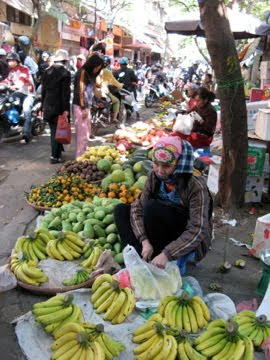
You plan to go to the market, not because you need to buy something but because you need to be reminded why you are in Vietnam. Last night you went to an expat bar and spoke English while dancing to Lady Gaga. You spent the morning reading about economics in English and texting American friends. With half an hour until lunch, you have almost enough time to escape the bubble and walk.
You close the tall iron gate of the pastel yellow French colonial house, a skinny, miniature version of the French equivalent, and walk past the badminton courts at the end of the residential block you always tell taxi drivers is yours, and where your Vietnamese family of two months lives. It is a lie, since your school pays these people every month and you have no biological relationship, but you can pretend. Today you don’t need a taxi because the market is in your neighborhood.
Hanoi is so oppressively humid that after a while your body does not register the heat; sweat glands work as they should, and no one judges the sweat stains on your elbow-length conservative shirt because everyone’s clothes are damp. Your sheets are damp when you wake up, your toothbrush is damp, the seat of your chair is damp, your damp notebooks are crinkled, your damp computer screen has spots of mold, your damp thighs slide together when you walk, and the steam rising from three hot meals does not fog your already fogged glasses.
Trees line your street, which is rare for this city, but you are confused about where these trees are actually planted, since looking up, all you see is a tangled mass. Green leaves connect to branches and green leaves connect to bundles of suspended electrical wires. Your knowledge of technology is limited but you are fairly certain those clumps of wire should not touch the way they are touching, especially since they are all so damp the copper has probably turned green like the Statue of Liberty. Each wire has a person and story on the other end but no one cares enough to make it straight. Maybe it is hopeless, you think. You try not to be ethnocentric but it is difficult.
Your street goes in a loop, not a grid, and the market is four blocks away to the left yet still bears the same street name. Hanoi’s haphazard plan does not bother you because at least it does not give you rashes or ruin your possessions or require three cold showers a day like the temperature. You walk with alacrity, your spongy black flip flops pattering to the beat of your gait, to show the Vietnamese couples staring that you are not a tourist—you know where your market is and how to get there. Having passed it every morning on the way to school, you know what to expect but today you decide to visit the stalls you ordinarily purposefully avoid, to get a zap of culture shock.
As your neighbors stare, you smile demurely and pretend this is all natural. Really though, your heart is pounding because it always thu-thumps with every motorcycle screech. Crossing the street, you get so close to the speeding drivers that you can see the labels on their jean waistbands—another fake Dolce & Gabbana. One day your white skin will be so distracting, the driver will not swerve. It happened once already, the teenage male driver with black hair gelled in spikes staring at your blue eyes with startling intensity, face frozen, but you ran across the cracked asphalt when you noticed his hands neglecting to reach for the hand brake, and your damp thighs slid together while you sprinted as the safety of the next crowded street approached.
The vendors cover some of the sidewalk slabs with heaps of used clothing and handbags so that you must retreat to the stream of Honda Dreams and Vespas with their shrill beeps, a Morse code that lets other drivers know their presence on the asphalt. The system is not foolproof and you have seen the evidence—battered metal and dazed, bloody Vietnamese men discarded on the side of the road. You have never seen even an indication of an ambulance, but you have learned that sometimes it is better not to ask questions.
It is better, also, not to ask how much something is. You enter the outdoor market through a narrow oval entrance in an alley wall lined with red bricks and are bombarded with the magenta, red, orange, lime green, deep green, and pale yellow colors of the fruit vendor stalls. Nothing has a set price because not even the price of dragonfruit is predictable. Instead you call out numbers, easy vocabulary, until an agreement is made. At first this was a fun game but because you are foreign, you are also wealthy, since one American dollar equals twenty thousand Vietnamese dong, so the game has turned guilty and panicked. The prickly scarlet balls of rambutan and the scaly pale green custard apples remain in their straw woven baskets and you continue onwards.
The phở smells like basil and the roasting chicken smells like a summer cookout. Oil crackles on portable gas stoves and Vietnamese families perch on small blue and red plastic stools, shoving noodles and meat into their mouths with chopsticks. The fragrances mix with smoke, making the moist air even thicker. You turn a corner and the lunch becomes raw. Gutted dogs lie on sticks ready for the rotisserie. Shelled sea urchins glisten in a heap. Bloody pig limbs rest in rows on a counter: slabs of meat, hoofs, and intestines. Silent, the butcher stares forlornly at the customers intently weaving through the vendor stalls.
A porcelain bowl of fat wiggling maggots is displayed on the curb and the vendor absentmindedly picks her nose. A cage of indignant roosters is tied to the back of an abandoned motorcycle. The birds screech at the discomfort, ignorant of the fact that soon they will be butchered, defeathered, and then plopped into boiling broth. This immediacy of your meals unsettles you, realizing that you prefer the anonymity of hamburger patties and chicken cutlets. Ducking under a blue tarp to evade the blinding sun, you discover another maze of stalls.
Withered frogs are displayed like sheets on a clothespin line, noodles on the floor in a dusty corner in twisted bundles like hay. Some vendors smile at you as you wander, but most stare blankly. Customers push past one another, competing for the competing vendors. Around another corner are plastic stickers and toys of animals, blonde dolls, and Ho Chi Minh. Further down the street are boxes of fake paper money and buckets bursting with bright flowers you can’t name. Each area of the market has a special purpose, from offering a meal to providing funeral décor. The market is the order in your chaotic Vietnamese life. This ancient system seems to work for the citizens, though economically speaking, you are stumped, since compartmentalizing the market heightens competition while demand remains constant. But you are not part of the system and regardless of what you say, you are not a citizen here and will never be.
Passing each middle aged woman selling identical flowers side by side, you notice lacquered bowls and vases across the street. You consider buying a lacquered item because of your newfound obsession with the haunting depth of the shiny, metallic technique but decide to wait until you are about to leave the country to stock up on appreciations. The Vietnam National Fine Arts Museum dedicates an exhibit to lacquer art and slowly meandering the dimly lit hall for the first time of many visits, the dark red and inky black tones make you quiver in the air-conditioned French villa, incredulous at the meticulous detail and the complex process necessary for lacquer technique. A cobalt vase gilded in gold perched on the market sidewalk curb glints in the sunlight and you look down at your toenails, newly painted with bright red glitter.
The market vendors are much less aggressive than the teenage vendors that wander the city streets with a box awkwardly dangling from their shoulders, selling scarves, postcards, and cigarette lighters. Market vendors shout at customers, customers shout at vendors, vendors shout at vendors, and customers shout at customers. No one shouts at you because you would not understand and do not belong in this market with the buzzing flies and whimpering dogs, scraping spoons and screaming children.
You are a woman, so you are at the market. Yet everyone sees through the lies. You weave through crowds and haggle persistently but you will never be a woman casually walking through the market. You will always be the girl whose knee length skirt is just a little too short, who slips in the trash that litters the curb, who takes pictures of anonymous houses because of a fascination with the foreign architecture, and who confuses the words “beef” and “father”. One morning last month you tried to ask your host mother if it would rain that day, she nodded, and you brought an umbrella to school; later that day, she was surprised to see you home because you had told her you were going shopping.
Passing a humming refrigerator stocked with local beer, you want to buy a sweating can but are unable to because your male friends are not here to buy alcohol and energy drinks and anything considered unfeminine for you. Your host sister calls them your bodyguards and coyly smiles when you assure her that you are not dating any of them.
You came to the market to be reminded of why you are here. You turn to retrace your steps because instead of finding the answer to your question, you encountered other people asking precisely the same thing. You walk at your brisk New York City pace now, not pausing to look at the pearl necklaces or t-shirts, yellow chicks or slowly scrambling turtles, gummy candies in the shape of Hoan Kiem temple or rainbow lollipops. You need to be home in time for lunch. You hope for tofu or summer rolls but it will probably be something involving grease in the hopes of fattening you up to make your American parents happy.
A group of middle aged, pajama-clad women perform vigorous arm thrashes, hops, and lunges in the badminton court at the end of your street. You have often seen Vietnamese adults engaging in this activity, and have never figured out what it is. The exercises remind you of tai chi on acid, or watered down aerobics. The Vietnamese value exercise but your host sisters hate moving, especially when it is hot. You were not aware that people could dislike walking. Because of their sloth, you feel like it is possible you are related to this Vietnamese family.
Except that you cannot be part of the family if you don’t have a key to the house. You ring the doorbell and scratch at a mosquito bite as you wait for your host mother to emerge from the kitchen. You beam and wave excitedly. Your host mother does not return the sentiment. She opens the door and asks you, “Cháu có vui vẻ tại thị trường? (Did you have fun at the market?)”
You pause, making sure your interpretation is correct before you respond, nodding, “Văng (Yes)”. You are glad you are home, though, and just in time for sweet green banana and snail soup, steamed white rice, garlic beef stir fry and spring rolls. It could be worse, you think, and help set the table.