My
neighbors in our Hanoi alley all wore loose, thin cotton outfit sets. I
wore capri jeans and elbow length tee shirts. They woke up at four for
morning lunges and arm swings. I woke up at six for my first of three
daily showers to rinse off the sweat and soot, followed by my routine sprint
for the bus to school. Their clothes were faded at the knees. Brown
squiggles traced old sweat stains. My clothes had brand labels on the
inside. Small rectangular indents on the corners of my skirts indicated
they had been recently washed and survived the drying process--no easy feat in
Hanoi's tropical humidity.
By
dinnertime, my Vietnamese host family would have changed into pajamas while I
was still in the black skirt and blouse I wore to school that day. Each
member had a token pajama outfit they wore every day. My host mother’s
was red with the Chinese symbol for longevity, my older sister Thư’s was yellow
with a large duck, and younger sister Chip’s was pastel pink sprinkled with
small flowers. My host father wore a thin-striped, light blue long
sleeved shirt with matching drawstring pants. Except for the drawstring,
he could have been going to the office instead of going to sleep.
"I
asked Ms. Huyen about Aliza's test," Thư announced to the family. "She did not score one hundred,
but she is still the best in the class." My host mother nodded with no change in her usual blank
facial expression, and continued spooning white rice from the cooker she had
propped on a stool, seated at the table with the rest of us. I had studied the vocabulary so that I
could float in the music of Vietnamese's six tones, not for earning high
grades. My gap year allowed me to
explore my curiosities about the language, but winning my host family's love
provided an added bonus.
As
the U.S. Embassy's summer intern, I returned to the same house two years later
for dinner, wearing the bright orange dress they had given me for my eighteenth
birthday. As I sat on the guest bench by the front door and waited for my
host mother to finish making beef phơ, I noted the same pale pink paint coated
the walls, the same cheap flower still life portraits displayed proudly in the
living room, and the same fold-out table taken out only for meals. They
wore their pajamas and exclaimed that I looked different--thinner, darker, more
Vietnamese. I put a hand at my ribcage, smoothing my skirt over my thighs
with the other hand. No, I assured them. I was still American.
All
American Foreign Service officers carry high heels or dress shoes, Ann Taylor
dresses or Brooks Brothers suits, blazers, and an American flag lapel pin when
they travel from post to post. As the face of the U.S. Government, my
coworkers want to look better than the foreign company representative or
ministry official with whom they meet.
I
carried second-hand business casual attire for my internship, the dress my host
family had bought me in my favorite color, an iPod, multiple pairs of flats in
preparation for the destructive monsoon season, a bikini, a camera with too
many functions, mascara and lipstick, a small teddy bear, running shoes,
self-doubt, a copy of the Aeneid with
split binding and multi-colored annotations, one pair of shorts, two
Vietnamese-English dictionaries, a Columbia University tee shirt, anticipatory
anxiety, a bag of Jelly Belly jellybeans for my host sister's birthday, a
journal, a pair of jeans with a suddenly irrelevant Metrocard in the front
pocket, an appetite for noodles, and a bottle of Sheer Blonde shampoo.
The
visiting Secretary of State wore her blonde hair in a hairsprayed bob. She donned a crimson blazer when she
stepped onto the Hanoi tarmac to greet the Ambassador. The vibrancy of her outfit combined
with the way she swung her arms out away from her body as she plodded forward
gave her a presence larger than her frame. I watched from a distance in my monochrome black dress, my
work requiring me to stay one step ahead of the Secretary to quell any
potential gaffes. I carried her
gifts of silk scarves and flowers from Vietnamese government officials, a framed
photograph from the Hilton Hotel, and a plaque from the American Chamber of
Commerce to the security conveyor belt for clearance. The following morning, at a thank you meeting with almost a
hundred Embassy staff members and their families, she and I happened to wear
the same white blazer. Her
pantsuit underneath was tailored and pressed, while the excess cloth of my
dress sagged.
“Your
government secretary is here,” a taxi driver commented in Vietnamese after the
usual friendly banter revealed my American nationality.
“I
know,” I sighed. “I'm already
exhausted.” Leaning my head
against the window, I imagined myself as a Foreign Service officer, or even an
Under Secretary, treating this visit--the security concerns, the furniture
arrangements of every conference room, the press, the carefully constructed
formalities--as just an average workday.
The
nondescript navy suit worn by Under Secretary Hormats made him seem
approachable and relaxed. He
carried slow, calculated gestures for the press cameras, stopping to examine
photos on the wall or shaking the Vietnamese Chamber of Commerce and
Information chairman’s hand for more seconds than necessary. Each word spoken was wrapped in a leaf
of silence, to allow Vietnamese reporters to quote him accurately. Sitting in the back of the van, I
carried questions about green energy and Hormats’ personal background but never
voiced them. I listened as the
deputy assistant, Matt Murray, briefed Hormats. His flowers and framed photograph sat on my lap. If the orange chrysanthemums and pink
lotus blossoms had been laced with anthrax, I would have become the martyr
intern of State.
Along
with Hormats' gifts, I possessed self-deprecating humor and knowledge of
Vietnam’s Pepsico plant layout.
Introducing myself to Matt Murray as the official government Blackberry
deliverer as we waited for pictures for which no one had invited us to pose, I
idled in the lobby before informing Murray that I had surveyed the factory
prior to his visit in my other role as the official government site
officer.
The
factory workers wore outfits in a navy color similar to Hormats' suit, but
stained brown and red. The
whirring of the bottling facility made the men look even more worn, crouching
near floor drains to empty the failed strawberry Sting, 7 Up and Aquafina
bottles. I gave them a weak wave,
to which they did not respond. My
tour guide through the plant asked me how many security officers Hormats
planned to bring.
"None--unless a Marine wants free Pepsi," I joked.
The Marines wore camouflaged blouses and
trousers, an outfit they referred to as "cammies," that they could
not wear outside of the tinted grey glass box where they stood watch for ten
hours. They returned my morning
wave before pressing the buzzer to unlock the security door. At all other times, they stood rigidly
in the back corner, their relaxed facial muscles displaying a false reticence.
"What
do you think about in the box all day?" I asked each Marine as one by one
they plopped down next to me at a house party and handed me a Saigon beer. Cage thought about his friends in
Afghanistan and all their pranks.
Anthony tried to think about nothing, but sometimes caught himself
remembering his dead father.
Decker thought about how fast he could get drunk and mapped out his bar
hopping route. Dre thought about
girls.
Dre
listed the meaning behind each ribbon pinned to his dress blues during the
Embassy's American Independence Day party: "Good conduct, meritorious
service, selected Marine Corps reserve, Afghanistan service. Um, this one's for being a drill
instructor. Bronze star."
Standing in a cotton dress among three strobe lit ice sculptures of
outstretched eagles, ten metal trays of American regional finger food such as
Maryland crab cakes, pigs-in-a-blanket pastries, and mini Tex-Mex burritos, and
hundreds of diplomats in three-piece suits and four-inch heels, I gave a
distrait nod after each explanation.
The
foreign Ambassadors invited to our Embassy’s party wore sensible grey and navy
suits; I wore bright pink. The
Ambassador to the Philippines told me bright colors were a good networking tool
because I would be more memorable and easy to spot in a large crowd. He advised me to contact him when I
visited Manila, offering to tour me through the landmarks. Only once he gave me his business card
did I know within which country Manila lay--all I could think about was the
creamy white color. An officer at
the Kuwait Embassy wrote his cell phone number on a cocktail napkin and
suggested I contact him so we could drink coffee more casually. Neither of us had business cards, but
something about a cocktail napkin seemed inappropriately sexy. The Ambassador from Angola wore baggy
pinstriped pants with upturned cuffs and bragged about the new business cards
he designed himself, before remembering to wish me a happy Independence
Day.
Each
time I stepped outside U.S. Embassy functions, my hair would twist into
ringlets from the humidity. I
wandered down unfamiliar streets in an effort to get lost, harangued by street
vendors stooping under the weight of the bamboo pole over their shoulder, from
which hung rice doughnuts or pineapple chunks. "You buy," they insisted, sneaking up behind me or
waiting for me at the corner, looking up into my eyes with woe. The shadow cast over their faces by
their conical hats, in addition to the faded cotton outfit in sepia tones, made
it hard for me to escape the guilt.
It was even harder to escape the street vendor. "No," I refused in
Vietnamese.
"Yes,"
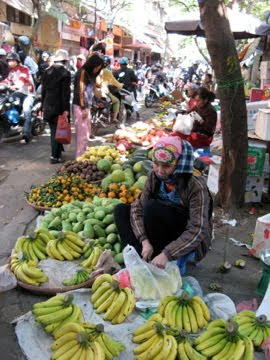
I nodded, nibbling a segment of stringy, syrupy jackfruit handed to me. The fruit vendor weighed more jackfruit
and tossed them into a pink plastic bag with longan berries, rambutan, three
dragonfruit, and a pomelo. Since
the total price amounted to less than a dollar, I nodded again and counted out
periwinkle Vietnamese dong.
"Thank
you, Ah-Leee-Zah. When are you
coming over for dinner?"
I
took the heavy bag from her. The
contents would be my dinner for the next week.
"Invite
me," I encouraged her. She
listed her number in my cell phone as "Thuy Qua Hoa," her name
followed by the Vietnamese word for fruit. Thuy wore the same pastel pink striped tee shirt and baggy
grey shorts every time I visited the outdoor market. I did not want to pressure her just because I had no
patience to cook. Unlike the other
grocery shoppers, I had no plans to turn my produce into creative meals. Dragonfruit and rambutan could be
filling, I assured myself.
After
scooping the white flesh out of a magenta dragonfruit skin with a spoon for
lunch, I met a new Vietnamese friend, Bơ, downtown for a hip-hop concert. I never made concrete plans to see the
Vietnamese strangers I spoke with, and would never eat dinner with Thuy Qua
Hoa. But Bơ, who called himself
Anh because his parents had given him the Vietnamese word for butter, met me in
his parents' musical instrument store.
His parents approved of our friendship, though Mr. Butter's sarcastic
jokes about the Embassy distressed me.
"Aliza
has a blog. She writes about how
corrupt the Vietnamese government is," Mr. Butter presented me to his
friends at the concert. Dressed in
dark skinny jeans, a collared beige shirt, and a black fedora, he was as
conspicuous in the sweaty crowd as I, with my Oxford blue polyester dress and
bulky camera. I denied the
introduction, shaking my head to the beat of Vietnamese spoken word
poetry. Emulating Brooklyn style,
the rappers wore wife beaters and bandana headbands, skinny jeans and baseball
caps, basketball sneakers and chains hanging from their belt loops and from
around their necks, and a tee shirt that read “I have plenty of talent and
vision, I just don’t give a shit!”.
“She's French, right?" one friend murmured
in Vietnamese.
“She’s
from Brooklyn,” Mr. Butter bragged, his shirt darkening with accumulated
sweat. I smiled politely, focusing
my gaze on the lacquer red columns gilded with outlines of dragons. The Vietnamese language can never sound
angry enough to rival Brooklyn hip-hop.
"She's
American," one employee corrected the others in the Consulate General
Office's restroom, chatting in Vietnamese as they applied lipstick and adjusted
their sheer blouses in front of the wall mirror. I stood behind them and rubbed mascara flakes from my
cheekbone. “She works at the
Embassy in Hanoi but is now here in Saigon.”
“She
looks like a princess,” sighed another employee.
“Hello,
my name is Aliza. I look forward
to working with you all,” I interjected in Vietnamese. I threw a paper towel in the trash and
left the restroom. Silenced, each
woman wore a bemused, slightly open grin on her face. Real princesses never feel invisible.
A
concrete wall surrounded the consulate compound. Next door stood the residence of the French Ambassador. If Ho Chi Minh City’s city planners
designed the layout of government buildings in such a way as to group those
countries with which Vietnam had grievances, then they did not punish the
United States or France. Trees
lined the boulevard next to the security wall, under which lay six tables with
oranges and avocados. Over the
years, this street had become known as Orange Juice Street. In the minute it took to walk from my
apartment in Somerset Serviced Residence to the security door, the scent of
oranges perfumed my ringlets. Once
inside, as I walked to the water cooler I would detect their phantom scent as I
turned my head.
One
of the employees, Vinh, would smile and wave every time I refilled my water
bottle at the water cooler. On my
last morning, she contorted her eyebrows and hurried up to me. “Do not wear pants anymore,” she
advised me in English. “They make
you look less like a princess.”
“Ohhhh,
I didn’t realize," I gasped.
"Thank you so much for telling me,” I stooped my back and placed a
hand on my chest as if catching my breath. I waited for Vinh to smile but she didn’t.
The
Hmong villagers smile constantly in the mountainous region of Sa Pa, a vacation
spot 38 kilometers from China.
Though the women’s hands are stained a dark teal from dyeing textiles,
their dispositions matched their bright multi-colored patchwork skirts and
jackets in heavy cotton. They
hiked up the vibrant green terraced fields wearing tightly bound cloth
slippers. I wore running sneakers
with grooves on the rubber soles for traction.
We
all were barefoot within the Cao Dai temple, in Tay Ninh, outside of Ho Chi
Minh City. Wearing a black tank
top and dark jeans, I sat behind a wall and watched through the doorframe. The worshippers in pristine white loose
pants and knee length tunics, the typical female Vietnamese dress known as ao
dai, and linen suits filed into the ceremonial hall and knelt in orderly rows
on the floor. The white grid of
people contrasted with the chaotic pink, blue, and yellow decor. Dragons snaked up columns, elaborate
altars with globes and glinting candelabras flanked both ends of the hall,
painted eyes watched from green windows, and staircases in the middle of the
space led to nowhere.
Nowhere
left to wander, I wore a tank top with a hidden money belt underneath. I carried the same suitcases back to
New York, with propaganda war prints instead of Sheer Blonde shampoo, Converse
sneakers from a Vietnamese factory instead of rain-wrinkled ballet flats, and
textile wall hangings instead of pajama shorts. They wore navy blazers, matching pencil skirts, and
plastered mauve smiles, from nowhere to nowhere.