Showing posts with label caribbean. Show all posts

Letter from Paradise, 18˚18'N, 76˚47'W


            Because I had already finished my ethnomusicology research paper and sunburned my fair skin enough times to not mind the sting and interviewed so many "locals" about solid waste management that I felt I was assuming superiority, I agreed, a restless eighteen-year-old girl with wild hair bleached blonde by the sea salt, to beach hop in Jamaica, where anxiety does not live and the sky is a vibrant blue or tangerine or pink and the people want to count your freckles.  There I would learn to be idle, there with the reggae music blasting from plantain carts, there with the three kinds of jerk chicken spice, there with the graffiti reminders to "calm dem down," there with the skateboarders and the drug dealers and the hair braiders and the bartenders and the pig farmers and the tour guides.
            I went, wary of Caribbean tourist culture.  I asserted myself as a sailing research student with S.E.A. Semester, not a spoiled brat runaway.  I had never surfed, had never jumped off a cliff into rolling teal waters, had never smoked ganja, had never climbed a Banyan tree with branches hovering over a cold lagoon, had never kicked a coral reef bed and feared resulting barracuda attacks as my blood mingled with the cobalt blue depths.  I brought Band-Aids for the cut on my foot and sunblock to reapply after swimming in every famous beach on Port Antonio.  Long Bay, Boston Bay, Annotto Bay.  Seashells and sea glass replaced the sandwiches that had filled my backpack.
            Father Tick Tock picked up a piece of aqua-colored sea glass from the sand.  The dusty pink flesh of his palm covered the edges of the piece.  The opaque, pockmarked glass glinted.  He looked like he held a piece of hard and dusty sky.
            "For you," he gestured.  I combed a stray ringlet behind my ear and shyly smiled, accepting.  "Whah you gonn' do with the glass?"
            "I don't know yet," I shrugged, looking down at the sand to avoid staring at his eye patch and bare chest.
            "It's deh prettiest garbage we 'ave," he boasted.  "I'm Sean.  Some call me Father Tick Tock.  What's your name?"
            "Aliza," I replied.  I began walking away.  He kept my pace, occasionally straying to pick up a glittering piece of glass.  After a few minutes of silent collecting, he offered me marijuana.  I explained that I was sailing under strict coast guard regulations.  He asked about my oceanographic research on marine debris and solid waste management systems.  I asked him for the story behind his name.
            "My name? There is no story.  Oh, wait. Yea man. So I had a bag filled with ganja, right.  Four pounds. No, four kilos. And the police, they come an' take me arms."  He crossed his arms, clutching an invisible bag. "I go like this"--he flung his arms out and with his elbows tight began to flap--"and fly away. So my friends call me Father Tick Tock. I'm still running from the police and time..." His story faded there.
            I nodded.  Most likely the actual event connected less with Father Tick Tock than the friend who christened him.  The sun-blasted garbage, carelessly tossed beer bottles and jam jars and food containers from Jamaica, other Caribbean islands, or anywhere in the path of the Sargasso Sea's current, tinkled in Father Tick Tock's hand.
            I refused the ring he twisted from a guava root for me.  I refused the ziplock bag of marijuana.  I refused his phone number.  I refused his offer to dreadlock my hair, already tangled by humidity.  I took his sea glass.

Adrift With Virgil

The water looks like it is covered with a film of cellophane and I could pop a swell bubble with a large needle. The ship creaks and metal jiggers clank lazily against the masts. Thick, coarse sailcloths slap and whisper in the faint breeze, which does little to alleviate the oppressively humid air. The soft grainy wood of the quarterdeck sticks to my flushed skin, and when I lift my calves, the dark grey imprint of my sweat remains on the planks. Sunscreen trickles down my back in white squiggles and my attempts to shield my bare shoulders from the sun are in vain. The sticky lotion oozes between my fingers as I smear sunscreen onto my freckled nose and over the prickly stubble of hair on my legs. Salt from my seawater hose showers and evaporated sweat sticks to the sunscreen in sharp, gritty crystals.
My favorite sound is the ocean but the sound disappears when there is no wind to make waves. The ship rocks slowly from side to side, port to starboard. I relish my ability to walk the 134-foot distance steadily, and this momentary hiatus allows my mottled bruises time to heal. I bang my shins vaulting into my bunk; my elbow is pink and puffed from hitting the belowdecks support column every time I pass the two gimbled tables swaying and laden with platters of burrito toppings or fresh bagels or glistening tomato soup; I stub my toe whenever I lose my balance in the laboratory; my cheek bone is still purple from the unexpected swell that knocked me forward while I was counting zooplankton under a microscope to estimate their population frequency; the bandaged scrape on my calf from when I fell through the bowsprit net while furling the JT threatens infection; and my hip has a large blue-grey tinge from when I fell into the oven handle while trying not to burn scones, which were thrown overboard anyway because I had distractedly added too much baking soda.
I am drifting somewhere in the North Atlantic Ocean, sailing on a two masted brigantine with nine cream colored sails I have set and struck, with two dozen lines I have hauled and heaved. A confetti of zooplankton and eroded plastic pieces skim the waves. Dolphins play in the frothy bow waves and sometimes their slippery, leathery skin becomes coated with the confetti. Belowdecks, the glossy wood-lined box with dusty, moldy maroon curtains where I sleep traps the hot air, making it difficult to breathe and resist the urge to tear my clothes off. No amount of fatigue makes a nap bearable in these conditions, and though typing on a steady computer screen in the library without swirling water darkening the porthole seems like a viable option while hovering in the entrance to the corner alcove and listening to the drone of the engine room next door, I decide to wait until sunset.
When I feel my days losing direction, I bring The Aeneid with me to the quarterdeck. The pages are folded and yellowing, the highlighted and annotated marks in orange, green and purple are blotched from spurts of seawater. The blue cover has detached from the text from too many affectionate readings. I am up to Book Four, having already read descriptions of Aeneas being tossed in Neptune’s waves as the Sargasso Sea has tossed me. Book Four details the frustrations with rigid plans. Aeneas just wants to continue having sex in caves with Dido. Rome can get founded another time. The sea has become a chore for Aeneas. The sparkling waves never change.
“I’ll be up all day,” I moan, letting my head rest on the edge of the quarterdeck hull. I close my eyes and sigh. A brown booby flies diagonally from broad on the starboard beam, diving to snatch helpless zooplankton from the flat surface of the sea. No waves propel the zooplankton or hide them from the enemy. Perhaps the booby is a disguised Mercury, sent by Jupiter to cajole us back to vitality. The minute hand jerks to twelve, a shrill ring reverberates through the quiet still air, and order is restored. A shipmate on watch leans over the rail of the opposite hull and peers at the taffrail log. “Great. 632.8 nautical miles,” she exclaims, crouching into the narrow doghouse entrance to record the result on the sprawling, faded map of the pastel blue Caribbean Sea, smudged pencil calculations of where we think we are, based on measurements of the sun’s position. In the last hour, we have sailed less than half a mile.
I could use a shower but fresh water is a rare commodity and today is not a Shower Day. Today is the day I write the discussion section of my oceanography research paper on the accumulation of plastics on Jamaican and Dominican beaches. Today is the day I finish my ethnomusicology paper on Dominican bachata music. Today is the day I don’t vomit over the side as saltwater stings my eyes because the wind died just when we all predicted it would be strongest. I had elected to sail for two months in the North Atlantic Ocean to appreciate the sea and stars, and to understand the historical hardships from Odysseus’ and Aeneas’ divergent journeys, to Columbus’ accidental discovery of America, to the calamitous 2010 earthquake in Haiti, but I am relieved every time conditions keep us from sailing, instead forcing us to drift aimlessly. As a native New Yorker, I rarely experience idleness.
Science textbooks on polished, wooden shelves line the white painted walls in the cramped furnace of the belowdecks library, secured with lines of frayed blue bungee cords. A large, white plastic fan with ELVIS KING scribbled deliriously in sharpie blows hot air at the textbooks like a hairdryer, fading the green and blue hues, and completely disregards the college students dressed in Patagonia tank tops and Billabong bathing suit bottoms with wispy hair coated in salt and oil, puzzling over Excel graph data. The books are never removed and opened. Instead, I address questions to scientists with PhDs or peer into buckets of net tow samples and petri dishes of sieved marine organisms. This is what science should be. Science is not fifty pages of small print or one hundred multiple choice questions. It is not a factor of my GPA, it is the adventure of gybing on a port tack to prepare for a Hydrocast deployment, and the surprising discovery of eighteen degree mode water in the Yucatán channel.
Science surrounds me, inescapable as Aeneas’ destiny. I watch my fatigued shipmates clamor to action at the sound of the hourly clock chime, measuring Beaufort force, wind and current direction, wave height, temperature, salinity, fluorescence, depth, and direction. Direction is the most difficult concept for me, much more than spectrophotometry or the principles of buoyancy. I steer off course more than on course and on slow days with no wind, it is just as hard to control the helm on calm days as on days when screaming wind tears at the sails and water splashes up one hull, slapping the opposite one. Juno should not feel threatened by me and I cannot comprehend why she would change the currents to lead me astray. “Forty degrees off course,” I call out in exasperated warning as per protocol.
While Aeneas can accuse Juno and the Fates for his misery, I alone am to blame for my wandering. Plans and directions are comforting but the strong pull of currents leads me astray to two hundred degrees off course. I am distracted by shiny possibilities like the phosphorescent esca in the central filament of an Anglerfish. I took a year between high school and college in order to explore and experiment, but unlike those in high school and college laboratories, these experiments are new and tactile. The samples I count are zooplankton that I snatched myself from the ocean at various precisely measured depths, killed with specific chemicals, and recorded according to standard procedure. The chlorophyll-a and the dissolved oxygen analyses I perform disturb beakers of the very seawater that envelops my floating home, the same seawater that abruptly soaks my clothes, soothes the urge to cut my hair when I stand under the fire hose, and cleans my laundry.
Neuston net tows glow at night, parading bioluminescence. After watching the net for half an hour, adjusting the boom to make sure the prized net is comfortable, I hoist it back on the lab deck. My hand reaches for the white plastic jar at the end—the codin jar. Unscrewing the jar fills me with the same excited anticipation as when I first translated the final lines of Book Twelve from Latin to English. The zooplankton is a slippery mass of pink goo, flashing neon green in flickers. A Sargassumfish wiggles through a chunk of beige, scratchy sargassum weed and a small seahorse lies motionless on an unidentifiable piece of red plastic. Though there is no indication of human life beyond the ship except for the occasional traffic threat two points off the starboard bow, signs of human destruction hover in the pelagic zone, waiting for innocent students to collect and count plastic shards and oil pellets.
I appreciate the discomfort that study abroad brings because as humans we rely so much on convenience. It is easier for a tourist to flick a cigarette a few inches from her beach towel than to walk to a trashcan. Jamaican locals would rather toss condoms and crackling food wrappers to be swept away into the ocean by wind. Dominicans dump cracked fishing crates and broken computers directly onto the sandy shoreline so they do not have to roam the streets searching for an evasive dumpster. The hopelessness of the situation, and the thousands of debris fragments I systematically collected from six tourist, local and unfrequented beaches, and fished from the surrounding turquoise Caribbean waters, is discouraging. Of course, because I am an indignant teenager, visions of torn, swollen diapers and black plastic bags studded with slate colored barnacles fill me with inspiration to save the world by majoring in environmental science—Two years of chemistry? No problem!—and restore the solid waste management of the negligent. Aeneas always put the care of his country before the convenience of remaining with Creüsa in Troy or lingering in Carthage with Dido.
The crewmembers on watch duty and the crewmembers woken from their naps join me for the daily two-hour lecture on the quarterdeck, the abrasive tar caulking between the heated planks inflicting burn blisters on the weary students. In the 105 degree Fahrenheit haze of misery, my hands and feet have broken into an itchy, puffy red rash from lack of sunscreen care. Someone tosses me a bottle of SPF 90 and I gratefully squeeze another coat onto the layers of grime that cover my sticky skin. Being allergic to the sun requires me to be constantly alert even when I am not responsible for ensuring the ship’s safety during watch duty. The sweltering air tempts my mind to wander and I have forgotten to hydrate again. My orange Nalgene bottle, scraped white in the places I’ve dropped it to cling fearfully to the rail, holds filtered water hot enough for tea. Considering the thoughts and brainstorms that send me on long-winded, forked roads of tangential mental distraction, I conclude these are not conditions appropriate for beginning a focused two-hour lecture.
Focus. Focus on the dripping sweat tickling sunburned skin. Focus on Captain Steve announcing mandatory Shower Day tonight. Focus on a to-do list of assignments that were put off until the wind returned, even though the threat of seasickness looms. Focus on the glassy translucent water, a vibrant dusky blue. Focus on the mangroves lecture. Focus on the knotty, mangled roots thick with skittering mangrove crabs. Focus on ship report updates. Focus on what happens after we dock in the United States again.
I lack direction, preferring instead to float like zooplankton and let the currents push me places. My friends never know where I am and a coworker once joked that I would soon rule my own island in the South Pacific. But zooplankton, the underdogs, are a crucial life form and one of the most complex and diverse of eukaryotic protists. They rely on the gravitational pull of the moon like Aeneas relied on the Fates, trusting that in the end purpose will be soothingly revealed and their suffering not in vain. The Fates have put me on this stationary ship stuck without anchoring somewhere in the middle of the vast expanse of cobalt blue water. I just hope King Aeolus sends one of his winds soon.

No Traffic Ahead


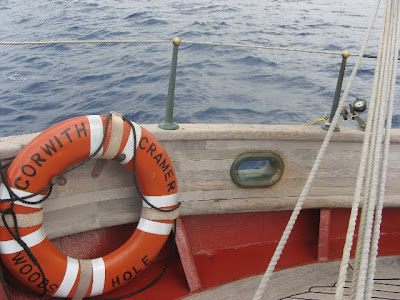
Perched at the tip of the bow I stare at the clouds quickly turning pastel pink to peach to pale orange to yellow to grey. The Cramer violently rocks up and down but my harness and tether keep me calm. My head shifts from left to right in opposition with the rhythm of the boat and my eyes rake the dusky blue horizon. No lights, no boats, no traffic ahead.
****
"How can I help?"

On the first day we were instructed to ask that question often. My first time on a boat about to set sail, I eagerly asked, "How can I help?"

The deckhand Ashley immediately responded, "I need you to grab your harness and be lookout."

I rushed down below deck, gathered my harness from my bunk and ran up to the bow. The boat was just starting to inch its way out of port in St. Croix. Luckily I had studied the plan of Cramer before departing so I knew where the bow was. I waited for Ashley to give me further instructions, my stomach tightening as I regretted what I had unknowingly volunteered for.

Ashley came up next to me and yelled over the sound of the engine, "You have to tell the captain about any buoys or boats you see. If you don't tell Steve we'll crash." Using her arms to signal the relative bearing system she called out DEADAHEADONETWOTHREE BROADONSTARBOARDBOWTHREETWOONE ONSTARBOARDBOW BROADONSTARBOARDQUARTER ONSTARBOARDQUARTER DEADASTERN ANDSAMETHINGFORTHEPORTSIDEOKAY?

The wind roared in my face as I squinted out at the ten green and red buoys bobbing in the water. Dead ahead. Lunging aft to warn Captain Steve, I forgot to unclip my tether and slipped on the deck. When I finally made it to the other side of the 134 foot boat, I hurriedly tested out the new vocabulary words. Tether unclipped in my hand, I raced back to my lookout post. Five more buoys. No, now seven. Ping! Unclip. Ping! Clip. Three white buoys, two sailboats, two red buoys, one green buoy. It began to rain and I blinked away droplets as they whipped my face. I slid on the slick wooden deck as I ran back and forth.

And then there was nothing but the waves battering against the boat and the turquoise horizon dead ahead.

As I unclipped my tether and turned around slowly I noticed the four lowers raised. I had been concentrating so intensely I did not see or hear my shipmates handling the sails behind me.

The other bow watches I have been assigned have been much quieter. Even at different times of the day and night the horizon looks the same--a dark grey sky cutting into a black sea at mid watch, a blue sky blending with a cobalt sea at morning watch, a pink sky illuminating a dark blue sea at dawn watch. Staring at the Atlantic Ocean for an hour or more cannot be compared with any activity done on land; it is a strange juxtaposition of extreme concentration and idle time. I sing as I cautiously turn my head to scan 360 degrees and look for traffic, the noises of the wind and waves drowning out the sound of my voice. And when my shipmate comes to relieve me from my post, I am relieved to report "No traffic ahead".

The Priest of Time


"What is the story behind your name?"

"My name? There is no st--oh wait a minute. Yea man. So I had a bag filled with ganja, right." He picked up a brown paper bag and clamped both hands on the opening. "Four pounds. No, four kilos. And the police, they come an' take me arms." Still holding the bag, he crossed his arms, making eye contact with each member of his audience. "I go like this"--he flung his arms out and with his elbows tight began to flap--"and fly away. So my friends call me Father Tick Tock. I'm still running from the police and time..." His story faded there.

I nodded. The story only slightly helped make sense of the wonderfully bizarre name, yet I understood. Most likely the actual event connected less with Father Tick Tock than the friend who christened him.

We were sitting in a small circle on the prickly grass near the ocean--Father Tick Tock, Tim, James, Lis, Hilary, and I. Father Tick Tock was crouching on his shiny red and black basketball shoes and the red mesh tank top and three gaudy necklaces hung out from his torso. He had initially approached us as soon as we arrived at Boston Bay to sell us marijuana but even after we refused, giving different reasons for why ranging from a shrug to an elaborate lie involving Coast Guard drug testing, he continued to be friendly and interested in talking with us.

Having Father Tick Tock close by, I was more comfortable wandering the shoreline looking for shells and seaglass by myself as Jamaican men interrupted my childish venture to hit on me. New York City instincts still caused my chest to tighten and for my mind to jump to fabrications (I don't have a phone, I'm moving and I don't know my address yet, I have a Canadian boyfriend named Robbie), but when I pointed to where my friends were and Burt or Will or Papa turned to look, I was able to continue scanning the ground. Will even picked up some seaglass for me.

As we walked to Jerk Centre, where he was generously taking us to his favorite vender for dinner, I realized that Father Tick Tock answered my question better than I would have. What is the story behind Babby Malouf Gubba Gubba Dumptruck on Fire? Magubbagubba? Or Piccola Anguria? Chica de Sol? Wheeze? Aliza, even? I don't know but I remember who called me by each name. Nicknames bring me closer to people and I often brainstorm new names to give friends and family. Loula--that's my friend Mallory. Daniel is Bruce, Patricia is Martha, Ellis is Alaska, Rebecca is Cribut, my grandmother is Mother Gooseberry.

I found it strange that Father Tick Tock would adopt us as friends without a business incentive. New Yorkers are known for being snobby and aloof and I could only be skeptical of the sunny Jamaicans. A New Yorker would never run home to sell his mesh tank tops to tourists like Father Tick Tock did for James and Tim. But a New Yorker would not have any mesh tank tops in his dresser drawer either.

The Crameid: Book One

I sing of a brigantine and seventeen students,
Who first set sail from the Virgin Islands;
They were not the first on the Cramer,
And will not be the last,
But the Caribbean waters were foreign to them.
From St. Croix to St. Maarten to Samaná, Dominican Republic
They were jostled and pushed by Neptune;
Most leaned over the side of the boat in anguish
As she rolled, but three strong ones--James, JP and Patricia--
Ate their fill of galley delights and lay down, satisfied,
In their cramped and musty bunks.

Tell me the reason, oh Muse, for the bioluminescence
Shining in the waves, almost as a reflection
Of the thousands of stars visible on clear nights.
Or of why there are no phyllosoma in the Sargasso Sea,
Or of how the clewl'n works to strike the tops'l.
How long would it take these seventeen students
To feel confident in their many jobs at sail in the Atlantic,
As a weather reader, a boat checker, an equipment deployer,
A line coiler, an assistant chef, a chlorophyll-a data processor,
An assistant engineer, a writer, a reader, a winkler,
A sailor.
Can such apathy hold the minds of professors?

There was a city they called Port Antonio--
Certainly welcomed by those who could not speak Spanish--
A city situated on the Atlantic Ocean, yet far
From the Dominican Republic from whence they came,
And the United States they think about often.
This land promised information about the Mooretown villagers,
About biodiversity and ecotourism, about reggae and literature.
The people would treat these seventeen students like tourists,
Which they were and were not simultaneously,
And some would feel uncomfortable looking at trinkets
While the island rocked back and forth like a large floating raft.

After adventures in Jamaica, presenting scientific findings
And hiking to marvel at green wonders not seen in the blue ocean
That the students would soon regard as their home,
They would set off on the last leg of their onerous journey
Up the Yucatán and back into the States.
The Captain prayed that King Aeolus would be kind
And offer them a favorable wind at little cost.
Once in Key West, a few would travel with family,
One would go see a space shuttle launch,
One would study for his LSATs,
And the rest would sail together to Charleston.

Just out of sight of Samaná, the students already
Had begun to wonder what would happen after
The Cramer had washed herself of the seventeen;
Would they ever be all together again?
The group had held together just as a copepod clinging to
A clump of Sargassum weed manages to nestle in a groove
And avoid being drowned in ethanol, instead being tossed
Once again back into the sea, a science evader.
Would all projects be turned in on time?
Would the water for the pasta ever boil in the galley?
The students constantly asked themselves questions.
Questions related to anxiety and homesickness,
Ignorance and frustration, curiosity and awe.
Hands to set the jib!
Which one is the jib downhaul again?