Showing posts with label market. Show all posts

The Things We Wore


            My neighbors in our Hanoi alley all wore loose, thin cotton outfit sets.  I wore capri jeans and elbow length tee shirts.  They woke up at four for morning lunges and arm swings.  I woke up at six for my first of three daily showers to rinse off the sweat and soot, followed by my routine sprint for the bus to school.  Their clothes were faded at the knees.  Brown squiggles traced old sweat stains.  My clothes had brand labels on the inside.  Small rectangular indents on the corners of my skirts indicated they had been recently washed and survived the drying process--no easy feat in Hanoi's tropical humidity.
            By dinnertime, my Vietnamese host family would have changed into pajamas while I was still in the black skirt and blouse I wore to school that day.  Each member had a token pajama outfit they wore every day.  My host mother’s was red with the Chinese symbol for longevity, my older sister Thư’s was yellow with a large duck, and younger sister Chip’s was pastel pink sprinkled with small flowers.  My host father wore a thin-striped, light blue long sleeved shirt with matching drawstring pants.  Except for the drawstring, he could have been going to the office instead of going to sleep.
            "I asked Ms. Huyen about Aliza's test," Thư announced to the family.  "She did not score one hundred, but she is still the best in the class."  My host mother nodded with no change in her usual blank facial expression, and continued spooning white rice from the cooker she had propped on a stool, seated at the table with the rest of us.  I had studied the vocabulary so that I could float in the music of Vietnamese's six tones, not for earning high grades.  My gap year allowed me to explore my curiosities about the language, but winning my host family's love provided an added bonus.
            As the U.S. Embassy's summer intern, I returned to the same house two years later for dinner, wearing the bright orange dress they had given me for my eighteenth birthday.  As I sat on the guest bench by the front door and waited for my host mother to finish making beef phơ, I noted the same pale pink paint coated the walls, the same cheap flower still life portraits displayed proudly in the living room, and the same fold-out table taken out only for meals.  They wore their pajamas and exclaimed that I looked different--thinner, darker, more Vietnamese.  I put a hand at my ribcage, smoothing my skirt over my thighs with the other hand.  No, I assured them.  I was still American.
            All American Foreign Service officers carry high heels or dress shoes, Ann Taylor dresses or Brooks Brothers suits, blazers, and an American flag lapel pin when they travel from post to post.  As the face of the U.S. Government, my coworkers want to look better than the foreign company representative or ministry official with whom they meet. 
I carried second-hand business casual attire for my internship, the dress my host family had bought me in my favorite color, an iPod, multiple pairs of flats in preparation for the destructive monsoon season, a bikini, a camera with too many functions, mascara and lipstick, a small teddy bear, running shoes, self-doubt, a copy of the Aeneid with split binding and multi-colored annotations, one pair of shorts, two Vietnamese-English dictionaries, a Columbia University tee shirt, anticipatory anxiety, a bag of Jelly Belly jellybeans for my host sister's birthday, a journal, a pair of jeans with a suddenly irrelevant Metrocard in the front pocket, an appetite for noodles, and a bottle of Sheer Blonde shampoo.
            The visiting Secretary of State wore her blonde hair in a hairsprayed bob.  She donned a crimson blazer when she stepped onto the Hanoi tarmac to greet the Ambassador.  The vibrancy of her outfit combined with the way she swung her arms out away from her body as she plodded forward gave her a presence larger than her frame.  I watched from a distance in my monochrome black dress, my work requiring me to stay one step ahead of the Secretary to quell any potential gaffes.  I carried her gifts of silk scarves and flowers from Vietnamese government officials, a framed photograph from the Hilton Hotel, and a plaque from the American Chamber of Commerce to the security conveyor belt for clearance.  The following morning, at a thank you meeting with almost a hundred Embassy staff members and their families, she and I happened to wear the same white blazer.  Her pantsuit underneath was tailored and pressed, while the excess cloth of my dress sagged.
            “Your government secretary is here,” a taxi driver commented in Vietnamese after the usual friendly banter revealed my American nationality. 
            “I know,” I sighed.  “I'm already exhausted.”  Leaning my head against the window, I imagined myself as a Foreign Service officer, or even an Under Secretary, treating this visit--the security concerns, the furniture arrangements of every conference room, the press, the carefully constructed formalities--as just an average workday. 
            The nondescript navy suit worn by Under Secretary Hormats made him seem approachable and relaxed.  He carried slow, calculated gestures for the press cameras, stopping to examine photos on the wall or shaking the Vietnamese Chamber of Commerce and Information chairman’s hand for more seconds than necessary.  Each word spoken was wrapped in a leaf of silence, to allow Vietnamese reporters to quote him accurately.  Sitting in the back of the van, I carried questions about green energy and Hormats’ personal background but never voiced them.  I listened as the deputy assistant, Matt Murray, briefed Hormats.  His flowers and framed photograph sat on my lap.  If the orange chrysanthemums and pink lotus blossoms had been laced with anthrax, I would have become the martyr intern of State.
            Along with Hormats' gifts, I possessed self-deprecating humor and knowledge of Vietnam’s Pepsico plant layout.  Introducing myself to Matt Murray as the official government Blackberry deliverer as we waited for pictures for which no one had invited us to pose, I idled in the lobby before informing Murray that I had surveyed the factory prior to his visit in my other role as the official government site officer. 
            The factory workers wore outfits in a navy color similar to Hormats' suit, but stained brown and red.  The whirring of the bottling facility made the men look even more worn, crouching near floor drains to empty the failed strawberry Sting, 7 Up and Aquafina bottles.  I gave them a weak wave, to which they did not respond.  My tour guide through the plant asked me how many security officers Hormats planned to bring.  "None--unless a Marine wants free Pepsi," I joked.
             The Marines wore camouflaged blouses and trousers, an outfit they referred to as "cammies," that they could not wear outside of the tinted grey glass box where they stood watch for ten hours.  They returned my morning wave before pressing the buzzer to unlock the security door.  At all other times, they stood rigidly in the back corner, their relaxed facial muscles displaying a false reticence.
            "What do you think about in the box all day?" I asked each Marine as one by one they plopped down next to me at a house party and handed me a Saigon beer.  Cage thought about his friends in Afghanistan and all their pranks.  Anthony tried to think about nothing, but sometimes caught himself remembering his dead father.  Decker thought about how fast he could get drunk and mapped out his bar hopping route.  Dre thought about girls.
            Dre listed the meaning behind each ribbon pinned to his dress blues during the Embassy's American Independence Day party: "Good conduct, meritorious service, selected Marine Corps reserve, Afghanistan service.  Um, this one's for being a drill instructor. Bronze star."  Standing in a cotton dress among three strobe lit ice sculptures of outstretched eagles, ten metal trays of American regional finger food such as Maryland crab cakes, pigs-in-a-blanket pastries, and mini Tex-Mex burritos, and hundreds of diplomats in three-piece suits and four-inch heels, I gave a distrait nod after each explanation. 
            The foreign Ambassadors invited to our Embassy’s party wore sensible grey and navy suits; I wore bright pink.  The Ambassador to the Philippines told me bright colors were a good networking tool because I would be more memorable and easy to spot in a large crowd.  He advised me to contact him when I visited Manila, offering to tour me through the landmarks.  Only once he gave me his business card did I know within which country Manila lay--all I could think about was the creamy white color.  An officer at the Kuwait Embassy wrote his cell phone number on a cocktail napkin and suggested I contact him so we could drink coffee more casually.  Neither of us had business cards, but something about a cocktail napkin seemed inappropriately sexy.  The Ambassador from Angola wore baggy pinstriped pants with upturned cuffs and bragged about the new business cards he designed himself, before remembering to wish me a happy Independence Day. 
             Each time I stepped outside U.S. Embassy functions, my hair would twist into ringlets from the humidity.  I wandered down unfamiliar streets in an effort to get lost, harangued by street vendors stooping under the weight of the bamboo pole over their shoulder, from which hung rice doughnuts or pineapple chunks.  "You buy," they insisted, sneaking up behind me or waiting for me at the corner, looking up into my eyes with woe.  The shadow cast over their faces by their conical hats, in addition to the faded cotton outfit in sepia tones, made it hard for me to escape the guilt.  It was even harder to escape the street vendor.  "No," I refused in Vietnamese.
            "Yes," I nodded, nibbling a segment of stringy, syrupy jackfruit handed to me.  The fruit vendor weighed more jackfruit and tossed them into a pink plastic bag with longan berries, rambutan, three dragonfruit, and a pomelo.  Since the total price amounted to less than a dollar, I nodded again and counted out periwinkle Vietnamese dong.
            "Thank you, Ah-Leee-Zah.  When are you coming over for dinner?"
            I took the heavy bag from her.  The contents would be my dinner for the next week.
            "Invite me," I encouraged her.  She listed her number in my cell phone as "Thuy Qua Hoa," her name followed by the Vietnamese word for fruit.  Thuy wore the same pastel pink striped tee shirt and baggy grey shorts every time I visited the outdoor market.  I did not want to pressure her just because I had no patience to cook.  Unlike the other grocery shoppers, I had no plans to turn my produce into creative meals.  Dragonfruit and rambutan could be filling, I assured myself.
            After scooping the white flesh out of a magenta dragonfruit skin with a spoon for lunch, I met a new Vietnamese friend, Bơ, downtown for a hip-hop concert.  I never made concrete plans to see the Vietnamese strangers I spoke with, and would never eat dinner with Thuy Qua Hoa.  But Bơ, who called himself Anh because his parents had given him the Vietnamese word for butter, met me in his parents' musical instrument store.  His parents approved of our friendship, though Mr. Butter's sarcastic jokes about the Embassy distressed me.
            "Aliza has a blog.  She writes about how corrupt the Vietnamese government is," Mr. Butter presented me to his friends at the concert.  Dressed in dark skinny jeans, a collared beige shirt, and a black fedora, he was as conspicuous in the sweaty crowd as I, with my Oxford blue polyester dress and bulky camera.  I denied the introduction, shaking my head to the beat of Vietnamese spoken word poetry.  Emulating Brooklyn style, the rappers wore wife beaters and bandana headbands, skinny jeans and baseball caps, basketball sneakers and chains hanging from their belt loops and from around their necks, and a tee shirt that read “I have plenty of talent and vision, I just don’t give a shit!”.
            “She's French, right?" one friend murmured in Vietnamese. 
“She’s from Brooklyn,” Mr. Butter bragged, his shirt darkening with accumulated sweat.  I smiled politely, focusing my gaze on the lacquer red columns gilded with outlines of dragons.  The Vietnamese language can never sound angry enough to rival Brooklyn hip-hop.
            "She's American," one employee corrected the others in the Consulate General Office's restroom, chatting in Vietnamese as they applied lipstick and adjusted their sheer blouses in front of the wall mirror.  I stood behind them and rubbed mascara flakes from my cheekbone.  “She works at the Embassy in Hanoi but is now here in Saigon.”
            “She looks like a princess,” sighed another employee.
            “Hello, my name is Aliza.  I look forward to working with you all,” I interjected in Vietnamese.  I threw a paper towel in the trash and left the restroom.  Silenced, each woman wore a bemused, slightly open grin on her face.  Real princesses never feel invisible.
            A concrete wall surrounded the consulate compound.  Next door stood the residence of the French Ambassador.  If Ho Chi Minh City’s city planners designed the layout of government buildings in such a way as to group those countries with which Vietnam had grievances, then they did not punish the United States or France.  Trees lined the boulevard next to the security wall, under which lay six tables with oranges and avocados.  Over the years, this street had become known as Orange Juice Street.  In the minute it took to walk from my apartment in Somerset Serviced Residence to the security door, the scent of oranges perfumed my ringlets.  Once inside, as I walked to the water cooler I would detect their phantom scent as I turned my head.
            One of the employees, Vinh, would smile and wave every time I refilled my water bottle at the water cooler.  On my last morning, she contorted her eyebrows and hurried up to me.  “Do not wear pants anymore,” she advised me in English.  “They make you look less like a princess.”
            “Ohhhh, I didn’t realize," I gasped.  "Thank you so much for telling me,” I stooped my back and placed a hand on my chest as if catching my breath.  I waited for Vinh to smile but she didn’t.
            The Hmong villagers smile constantly in the mountainous region of Sa Pa, a vacation spot 38 kilometers from China.  Though the women’s hands are stained a dark teal from dyeing textiles, their dispositions matched their bright multi-colored patchwork skirts and jackets in heavy cotton.  They hiked up the vibrant green terraced fields wearing tightly bound cloth slippers.  I wore running sneakers with grooves on the rubber soles for traction.
            We all were barefoot within the Cao Dai temple, in Tay Ninh, outside of Ho Chi Minh City.  Wearing a black tank top and dark jeans, I sat behind a wall and watched through the doorframe.  The worshippers in pristine white loose pants and knee length tunics, the typical female Vietnamese dress known as ao dai, and linen suits filed into the ceremonial hall and knelt in orderly rows on the floor.  The white grid of people contrasted with the chaotic pink, blue, and yellow decor.  Dragons snaked up columns, elaborate altars with globes and glinting candelabras flanked both ends of the hall, painted eyes watched from green windows, and staircases in the middle of the space led to nowhere.
            Nowhere left to wander, I wore a tank top with a hidden money belt underneath.  I carried the same suitcases back to New York, with propaganda war prints instead of Sheer Blonde shampoo, Converse sneakers from a Vietnamese factory instead of rain-wrinkled ballet flats, and textile wall hangings instead of pajama shorts.  They wore navy blazers, matching pencil skirts, and plastered mauve smiles, from nowhere to nowhere.
Da Hongmen Market


Da Hongmen Market's facade looks like a sports arena, with white concrete spanning a whole city block.  Outside, fruit vendors stand silently by their carts of mangosteen, cherries, bananas, and apples.  Crowds of people mill about in every direction, slapping against the transparent plastic strips that cover the entrance.  Da Hongmen does not seem like a social mall: customers arrive with a specific purpose and leave quickly with those items.  The market sells an overwhelming number of things.  Since the market organizes its products by floor, people go directly to the area that features the products they came to purchase.
            On each floor, the rows of stalls sell very similar items.  On the second floor, specializing in women's cotton shirts and skirts, the clothes blur as customers walk down the aisles.  Adjacent stalls often sell the exact same garment style, including mistranslated English phrases, misspelled designer brands, bright colors, sequins or rhinestones, or lace.  The notable stores were those that differed from the trend, selling clothing from Chinese ethnic groups or specialty clothing like wedding dresses.
            Since the Da Hongmen stalls lack variety, merchants distinguish themselves through quality and customer service rather than creative design.  The owner does not always oversee the stall, instead hiring a young woman to handle business transactions.  These women sit on small stools, wearing the clothes they sell.  No one tries to usher passersby into a stall.  No stalls advertise limited discount sales or a new commodity.  Incentives do not seem necessary in Da Hongmen Market.
            After asking the bored stall clerks if they were the owner, their boss would rush over and tell us about slowing growth or new business plans.  He--always the owner was a he--would stand with his hands on his hips, nodding emphatically.  If the owner were not at the market, the young stall clerks would discuss the doldrums of market work more honestly.
            "Would you move somewhere else?  What would you do?" I asked.
            Most had never considered deviating from the paths set out for them by their family.  If they had dreams, they did not care to share them with an inquisitive foreigner.
            "I'm the third generation in this business," a fur merchant boasted, twirling the silver rings on his fingers.  "I wouldn't change my life for anything."  The front of his shop was composed entirely of a large swath of shiny metal to attract customers.  His store was on the top floor, the level designated for expensive goods. 
            Location seems to affect business almost as much as the actual products sold.  With only one staircase in the market, those stalls next to the stairs have a greater advantage over those stalls further away.  If a stall sells items that do not match the floor's theme, the rent is cheaper.  For example, on the third floor, which specializes in trousers, I spoke with the owner of a stationery supplies stall.  The owner could not find a space on the first floor, but has been doing well regardless.  Most of his customers are other shopkeepers because they know where he is located.
            Da Hongmen Market vendors have their origins outside Beijing.  Most are the second or even third generation in that business, even though I expected Da Hongmen to be the destination for first generation entrepreneurs hoping to pursue greater opportunities outside of their rural hometowns.  Some vendors spoke of their hometown with nostalgia, and chose to send their children to school back there to expose them to their traditions, rather than a school in Beijing.  But they all associated Beijing with prosperity and no one wanted to leave the city permanently.
            Beijing carries a sense of hope for migrant workers, as if it were the city of possibility.  After learning about the discrimination that migrant workers face in Beijing as strangers in their own city, their positive connotations associated with Beijing perplexed me.  The overwhelming bustle of people, schools churning out business majors like a factory, and factories churning out smoke and nitrous oxides seem to counter that optimism.

Market Hunting

You plan to go to the market, not because you need to buy something but because you need to be reminded why you are in Vietnam. Last night you went to an expat bar and spoke English while dancing to Lady Gaga. You spent the morning reading about economics in English and texting American friends. With half an hour until lunch, you have almost enough time to escape the bubble and walk.
You close the tall iron gate of the pastel yellow French colonial house, a skinny, miniature version of the French equivalent, and walk past the badminton courts at the end of the residential block you always tell taxi drivers is yours, and where your Vietnamese family of two months lives. It is a lie, since your school pays these people every month and you have no biological relationship, but you can pretend. Today you don’t need a taxi because the market is in your neighborhood.
Hanoi is so oppressively humid that after a while your body does not register the heat; sweat glands work as they should, and no one judges the sweat stains on your elbow-length conservative shirt because everyone’s clothes are damp. Your sheets are damp when you wake up, your toothbrush is damp, the seat of your chair is damp, your damp notebooks are crinkled, your damp computer screen has spots of mold, your damp thighs slide together when you walk, and the steam rising from three hot meals does not fog your already fogged glasses.
Trees line your street, which is rare for this city, but you are confused about where these trees are actually planted, since looking up, all you see is a tangled mass. Green leaves connect to branches and green leaves connect to bundles of suspended electrical wires. Your knowledge of technology is limited but you are fairly certain those clumps of wire should not touch the way they are touching, especially since they are all so damp the copper has probably turned green like the Statue of Liberty. Each wire has a person and story on the other end but no one cares enough to make it straight. Maybe it is hopeless, you think. You try not to be ethnocentric but it is difficult.
Your street goes in a loop, not a grid, and the market is four blocks away to the left yet still bears the same street name. Hanoi’s haphazard plan does not bother you because at least it does not give you rashes or ruin your possessions or require three cold showers a day like the temperature. You walk with alacrity, your spongy black flip flops pattering to the beat of your gait, to show the Vietnamese couples staring that you are not a tourist—you know where your market is and how to get there. Having passed it every morning on the way to school, you know what to expect but today you decide to visit the stalls you ordinarily purposefully avoid, to get a zap of culture shock.
As your neighbors stare, you smile demurely and pretend this is all natural. Really though, your heart is pounding because it always thu-thumps with every motorcycle screech. Crossing the street, you get so close to the speeding drivers that you can see the labels on their jean waistbands—another fake Dolce & Gabbana. One day your white skin will be so distracting, the driver will not swerve. It happened once already, the teenage male driver with black hair gelled in spikes staring at your blue eyes with startling intensity, face frozen, but you ran across the cracked asphalt when you noticed his hands neglecting to reach for the hand brake, and your damp thighs slid together while you sprinted as the safety of the next crowded street approached.
The vendors cover some of the sidewalk slabs with heaps of used clothing and handbags so that you must retreat to the stream of Honda Dreams and Vespas with their shrill beeps, a Morse code that lets other drivers know their presence on the asphalt. The system is not foolproof and you have seen the evidence—battered metal and dazed, bloody Vietnamese men discarded on the side of the road. You have never seen even an indication of an ambulance, but you have learned that sometimes it is better not to ask questions.
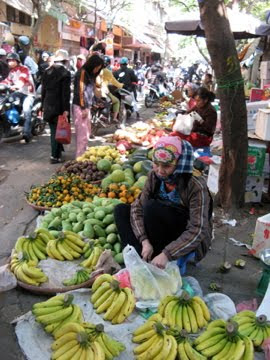
It is better, also, not to ask how much something is. You enter the outdoor market through a narrow oval entrance in an alley wall lined with red bricks and are bombarded with the magenta, red, orange, lime green, deep green, and pale yellow colors of the fruit vendor stalls. Nothing has a set price because not even the price of dragonfruit is predictable. Instead you call out numbers, easy vocabulary, until an agreement is made. At first this was a fun game but because you are foreign, you are also wealthy, since one American dollar equals twenty thousand Vietnamese dong, so the game has turned guilty and panicked. The prickly scarlet balls of rambutan and the scaly pale green custard apples remain in their straw woven baskets and you continue onwards.
The phở smells like basil and the roasting chicken smells like a summer cookout. Oil crackles on portable gas stoves and Vietnamese families perch on small blue and red plastic stools, shoving noodles and meat into their mouths with chopsticks. The fragrances mix with smoke, making the moist air even thicker. You turn a corner and the lunch becomes raw. Gutted dogs lie on sticks ready for the rotisserie. Shelled sea urchins glisten in a heap. Bloody pig limbs rest in rows on a counter: slabs of meat, hoofs, and intestines. Silent, the butcher stares forlornly at the customers intently weaving through the vendor stalls.
A porcelain bowl of fat wiggling maggots is displayed on the curb and the vendor absentmindedly picks her nose. A cage of indignant roosters is tied to the back of an abandoned motorcycle. The birds screech at the discomfort, ignorant of the fact that soon they will be butchered, defeathered, and then plopped into boiling broth. This immediacy of your meals unsettles you, realizing that you prefer the anonymity of hamburger patties and chicken cutlets. Ducking under a blue tarp to evade the blinding sun, you discover another maze of stalls.
Withered frogs are displayed like sheets on a clothespin line, noodles on the floor in a dusty corner in twisted bundles like hay. Some vendors smile at you as you wander, but most stare blankly. Customers push past one another, competing for the competing vendors. Around another corner are plastic stickers and toys of animals, blonde dolls, and Ho Chi Minh. Further down the street are boxes of fake paper money and buckets bursting with bright flowers you can’t name. Each area of the market has a special purpose, from offering a meal to providing funeral décor. The market is the order in your chaotic Vietnamese life. This ancient system seems to work for the citizens, though economically speaking, you are stumped, since compartmentalizing the market heightens competition while demand remains constant. But you are not part of the system and regardless of what you say, you are not a citizen here and will never be.
Passing each middle aged woman selling identical flowers side by side, you notice lacquered bowls and vases across the street. You consider buying a lacquered item because of your newfound obsession with the haunting depth of the shiny, metallic technique but decide to wait until you are about to leave the country to stock up on appreciations. The Vietnam National Fine Arts Museum dedicates an exhibit to lacquer art and slowly meandering the dimly lit hall for the first time of many visits, the dark red and inky black tones make you quiver in the air-conditioned French villa, incredulous at the meticulous detail and the complex process necessary for lacquer technique. A cobalt vase gilded in gold perched on the market sidewalk curb glints in the sunlight and you look down at your toenails, newly painted with bright red glitter.
The market vendors are much less aggressive than the teenage vendors that wander the city streets with a box awkwardly dangling from their shoulders, selling scarves, postcards, and cigarette lighters. Market vendors shout at customers, customers shout at vendors, vendors shout at vendors, and customers shout at customers. No one shouts at you because you would not understand and do not belong in this market with the buzzing flies and whimpering dogs, scraping spoons and screaming children.
You are a woman, so you are at the market. Yet everyone sees through the lies. You weave through crowds and haggle persistently but you will never be a woman casually walking through the market. You will always be the girl whose knee length skirt is just a little too short, who slips in the trash that litters the curb, who takes pictures of anonymous houses because of a fascination with the foreign architecture, and who confuses the words “beef” and “father”. One morning last month you tried to ask your host mother if it would rain that day, she nodded, and you brought an umbrella to school; later that day, she was surprised to see you home because you had told her you were going shopping.
Passing a humming refrigerator stocked with local beer, you want to buy a sweating can but are unable to because your male friends are not here to buy alcohol and energy drinks and anything considered unfeminine for you. Your host sister calls them your bodyguards and coyly smiles when you assure her that you are not dating any of them.
You came to the market to be reminded of why you are here. You turn to retrace your steps because instead of finding the answer to your question, you encountered other people asking precisely the same thing. You walk at your brisk New York City pace now, not pausing to look at the pearl necklaces or t-shirts, yellow chicks or slowly scrambling turtles, gummy candies in the shape of Hoan Kiem temple or rainbow lollipops. You need to be home in time for lunch. You hope for tofu or summer rolls but it will probably be something involving grease in the hopes of fattening you up to make your American parents happy.
A group of middle aged, pajama-clad women perform vigorous arm thrashes, hops, and lunges in the badminton court at the end of your street. You have often seen Vietnamese adults engaging in this activity, and have never figured out what it is. The exercises remind you of tai chi on acid, or watered down aerobics. The Vietnamese value exercise but your host sisters hate moving, especially when it is hot. You were not aware that people could dislike walking. Because of their sloth, you feel like it is possible you are related to this Vietnamese family.
Except that you cannot be part of the family if you don’t have a key to the house. You ring the doorbell and scratch at a mosquito bite as you wait for your host mother to emerge from the kitchen. You beam and wave excitedly. Your host mother does not return the sentiment. She opens the door and asks you, “Cháu có vui vẻ tại thị trường? (Did you have fun at the market?)”
You pause, making sure your interpretation is correct before you respond, nodding, “Văng (Yes)”. You are glad you are home, though, and just in time for sweet green banana and snail soup, steamed white rice, garlic beef stir fry and spring rolls. It could be worse, you think, and help set the table.