I remember blackouts


The blackness is so thick I can almost curl my fingers around it and tug. But I can’t and the humid darkness remains. I scoot back against a chair and hug my knees to my chest, silent. I blink. I blink. My sixteen-year-old Vietnamese host sister, Chịp, wails in frustration. With a language like a song, I am impressed my sister can manage an emotive tone.

The living room of my host family’s house was just starting to become familiar and now foreignness envelops me once more. I try to picture the wooden bench up against the window, the matching chairs and the painting of a vase with flowers perched above it, the other painting of a meadow on the opposite wall, the television with a cheerful blond Norwegian-looking doll and a snow globe of New York City resting on top, and the beaded entranceway to the kitchen, the only place in Viet Nam where I don’t feel welcome.

It had only been two weeks—my feet beginning to break in the stiff plastic house sandals given to me by my host family—and already I no longer noticed the pedestrians calling out to me in the streets or staring at me on the bus, the thin limbs in mismatched and faded clothing, the challenge that thick motorcycle traffic imposes on my daily routine, the lingering sticky-sweet stench of the durian fruit vendor, or the heavy black smoke of burning paper ancestral offerings.

My twenty-four-year-old Vietnamese host sister, Thư, stomps and claps and smashes into the piano keyboard. Suddenly a small lantern illuminates Thu’s motherly smile and the bottom of her plastic magenta eyeglasses. My host mother, I imagine, remains rigid and reserved on the hard wooden bench like usual. At first I had thought my host mother resented my existence but I soon came to understand that she was just dutifully fulfilling her role as a woman: demure and unobtrusive. I unfold from my twisted confusion and rejoin the huddle in the middle of the floor.

We had been watching a movie on Chịp’s favorite channel, the Disney channel, on a Monday night. Hilary Duff had enrolled in a naval academy and the moral was that she was girly yet did not give up at school. Each shot of camouflage, boot camp exercises, rifles, or any other indication of warfare made me uncomfortable since the Vietnam War, known as the American War in Vietnam, had never been mentioned in the family. My host parents had certainly lived through the war but I did not know the extent of their involvement or how strong their sentiments were. Did they intrinsically hate Americans and I was just an exception? Was I an exception?

Glancing at the clock and then back at Hilary Duff, I had hoped that silently sitting on the beige tiled floor with my host family and watching a squeaky blonde girl get covered in mud would help me break down the barrier separating guest from adopted daughter and sister. The family has already changed into pajamas while I am still in the skirt and blouse I wore to school that day. Each member has a token pajama outfit they wear every day. My host mother’s is red with the Chinese symbol for longevity, Thư’s is yellow with a large duck, and Chịp’s is pastel pink sprinkled with small flowers. My host father does not have pajamas, from what I can see.

I stare at the three women engulfed in shadows. They chatter amiably amongst themselves as the sweat starts trickling down the sides of my face. “Xin lỗi, em (I’m sorry),” Thu apologizes to me. I shake my head and then remember I can’t rely on gestures to communicate anymore. “Tốt (Okay),” I squeak.

My index finger traces my miniature Vietnamese-English dictionary; once, twice, three times. I fidget with the pages, feeling the softness of wear. I consider casually commenting on the sudden heat influx but can’t remember which tone to use. Having learned three romance languages, I am used to relying on cognates and intuition. In Hanoi, I flounder in the music of the sentences.

With the patter of plastic blue slippers, my host father climbs down two flights of spiraling marble with a battery-powered fan the size of a basketball. He hovers over us momentarily and then disappears back up into the silent abyss. A gaunt man with monochrome clothes that hang from his stooped body, my host father still fulfills the stereotypical Vietnamese patriarchal role as the aloof provider of the family. I never see him joking or playing with my host sisters or even touching my host mother. Though my host sisters have shown me wedding pictures in which my host mother actually smiled, I have no idea how they met or decided to get married. Without access to the computer and therefore his digital games of solitaire, I don’t know what he plans on doing tonight.

Chịp begins belting out her favorite Korean pop songs. Thư encourages me to sing along but I laugh nervously instead. Mosquitoes, lacquer-green beetles and feathery moths dance around the lantern. I slap at my arms and scratch the insect bites. There is nowhere to look but at the light.

As soon as Chịp finishes her Korean warbling, I rush up the stairs to the master bedroom, my new room, the bedroom that my host parents relinquished so that I, as the American, can feel comfortable, while they sleep on mats in the third floor computer room. Though they are in their fifties and I am only seventeen years old, I am embarrassed to reject their generosity.

I yank open the first desk drawer, where I remember I put a photo album. Back downstairs, we flip through the laminated pages and I proudly blurt out family vocabulary: mother, father, older brother, aunt, grandmother, cousins. My host mother repeatedly exclaims, “Tóc vàng (blond)!” I have not been blonde since I was ten years old, but since I don’t have the sleek and shiny black hair of all Vietnamese people, I can be whatever my host family wants me to be. Which, of course, is blond. I am almost afraid to tan in the tropical sun, in case my coveted pale skin becomes slightly more like their glowing brown.

Suddenly the power is restored and the television flickers back on just in time for the last minute of the movie. Hilary Duff successfully graduates from naval academy, or peace is restored in her household, or something of that nature. We shut off the television and disperse to finish my economics reading (me), a trigonometry worksheet (Chịp), an English lesson plan for the class she teaches to four year olds (Thư), and the laundry (my host mother).

An hour and a half later, the black print of my textbook quickly grows to envelop the whole room. I open the door—blackness there too. My host father appears once again to hand out necessities: a lantern for my room and one for my host sisters’ room. I offer him my flashlight but he shakes his head. I shine my light on the stairs so he won’t fall as he retreats into solitude, his hacking cough echoing in the hallway.

Choosing to interpret this blackout as an involuntary study break, I join the insects around Chịp and Thư’s lantern. The three of us share riddles and quiz each other on Vietnamese and English vocabulary. My sisters are far beyond the “table” and “chair” stage while I have to repeat “bed” and “window”. I feel like I’m at an elementary school slumber party of overachieving nerds. When the lights illuminate the house again after half an hour of giggling, we reluctantly return to our desks.

The third blackout of the night, two hours later, finds me reading The Quiet American. I sigh, exasperated, stumble towards my wardrobe, and change into my pajamas. “Chúc ngủ ngôn (Good night),” I call out to my sisters. They return the sentiment. From my room I can see Chịp huddled by a lantern, frantically trying to finish her trigonometry homework. Though I also have homework, I decide to save it for the following day when the city’s electricity functions again.

I feel shepherded by the city of Hanoi. Its bus system determines the times I arrive to school, return back home, or travel to my voice teacher’s house. Its weather determines what I will eat that day, since my host mother buys ingredients fresh every morning at the local market two blocks away. Its citizens determine how I view myself—pretty or ugly, short or tall, chubby or fat, pale or very white, endangered or flattered. And its electricity determines how efficiently my workload diminishes.

The following day is more humid than usual. I arrive home to learn of another blackout, which had just ended. Relieved that I missed it, I stack my books in order of priority on my desk and settle in for a long night, which will only be interrupted by the mind game that is a Vietnamese family dinner. At dinner I try and make my bowl of rice last as long as my family’s three helpings. I chew individual grains, I chew air, I keep my bowl raised so no one plops more jellyfish or chicken fat into it. Whatever is in the rice bowl must be consumed. It is an unwritten law.

Halfway through studying for an environmental science quiz, the power goes out. No. No no no. I take out my flashlight, prop it between my teeth, and continue working, fanning myself with my left hand. My clothes quickly turn damp, then wet. Would this become a daily routine? Though blackouts cause no more than an inconvenience for me, which should be expected when traveling to a developing country, the uncertainty and confusion lead me to despair.

The blackouts last anywhere from ten minutes, a taunt, to three hours, a punishment. In New York City, this pattern would be classified as a national catastrophe. There would be television news, editorials, investigative commissions, political inquiries, and blue ribbon panels. In Hanoi, it is just part of the summer. My family seems to have accepted that the power is beyond their power.

After the sixth blackout that week, the block erupts into cheers when the electricity is restored again. Joining in with an American “Woo!” I feel connected with my neighbors. But no one ever seems angry and the blackouts are hardly even mentioned. The idea of protesting to a government when services are not adequate is just as foreign for them as blackouts are for me.

Next Destination: College

I am a staff writer for Columbia's journal of world travel, NOW!HERE. The first issue of the semester is out:

No Traffic Ahead


Perched at the tip of the bow I stare at the clouds quickly turning pastel pink to peach to pale orange to yellow to grey. The Cramer violently rocks up and down but my harness and tether keep me calm. My head shifts from left to right in opposition with the rhythm of the boat and my eyes rake the dusky blue horizon. No lights, no boats, no traffic ahead.
****
"How can I help?"

On the first day we were instructed to ask that question often. My first time on a boat about to set sail, I eagerly asked, "How can I help?"

The deckhand Ashley immediately responded, "I need you to grab your harness and be lookout."

I rushed down below deck, gathered my harness from my bunk and ran up to the bow. The boat was just starting to inch its way out of port in St. Croix. Luckily I had studied the plan of Cramer before departing so I knew where the bow was. I waited for Ashley to give me further instructions, my stomach tightening as I regretted what I had unknowingly volunteered for.

Ashley came up next to me and yelled over the sound of the engine, "You have to tell the captain about any buoys or boats you see. If you don't tell Steve we'll crash." Using her arms to signal the relative bearing system she called out DEADAHEADONETWOTHREE BROADONSTARBOARDBOWTHREETWOONE ONSTARBOARDBOW BROADONSTARBOARDQUARTER ONSTARBOARDQUARTER DEADASTERN ANDSAMETHINGFORTHEPORTSIDEOKAY?

The wind roared in my face as I squinted out at the ten green and red buoys bobbing in the water. Dead ahead. Lunging aft to warn Captain Steve, I forgot to unclip my tether and slipped on the deck. When I finally made it to the other side of the 134 foot boat, I hurriedly tested out the new vocabulary words. Tether unclipped in my hand, I raced back to my lookout post. Five more buoys. No, now seven. Ping! Unclip. Ping! Clip. Three white buoys, two sailboats, two red buoys, one green buoy. It began to rain and I blinked away droplets as they whipped my face. I slid on the slick wooden deck as I ran back and forth.

And then there was nothing but the waves battering against the boat and the turquoise horizon dead ahead.

As I unclipped my tether and turned around slowly I noticed the four lowers raised. I had been concentrating so intensely I did not see or hear my shipmates handling the sails behind me.

The other bow watches I have been assigned have been much quieter. Even at different times of the day and night the horizon looks the same--a dark grey sky cutting into a black sea at mid watch, a blue sky blending with a cobalt sea at morning watch, a pink sky illuminating a dark blue sea at dawn watch. Staring at the Atlantic Ocean for an hour or more cannot be compared with any activity done on land; it is a strange juxtaposition of extreme concentration and idle time. I sing as I cautiously turn my head to scan 360 degrees and look for traffic, the noises of the wind and waves drowning out the sound of my voice. And when my shipmate comes to relieve me from my post, I am relieved to report "No traffic ahead".

The Priest of Time


"What is the story behind your name?"

"My name? There is no st--oh wait a minute. Yea man. So I had a bag filled with ganja, right." He picked up a brown paper bag and clamped both hands on the opening. "Four pounds. No, four kilos. And the police, they come an' take me arms." Still holding the bag, he crossed his arms, making eye contact with each member of his audience. "I go like this"--he flung his arms out and with his elbows tight began to flap--"and fly away. So my friends call me Father Tick Tock. I'm still running from the police and time..." His story faded there.

I nodded. The story only slightly helped make sense of the wonderfully bizarre name, yet I understood. Most likely the actual event connected less with Father Tick Tock than the friend who christened him.

We were sitting in a small circle on the prickly grass near the ocean--Father Tick Tock, Tim, James, Lis, Hilary, and I. Father Tick Tock was crouching on his shiny red and black basketball shoes and the red mesh tank top and three gaudy necklaces hung out from his torso. He had initially approached us as soon as we arrived at Boston Bay to sell us marijuana but even after we refused, giving different reasons for why ranging from a shrug to an elaborate lie involving Coast Guard drug testing, he continued to be friendly and interested in talking with us.

Having Father Tick Tock close by, I was more comfortable wandering the shoreline looking for shells and seaglass by myself as Jamaican men interrupted my childish venture to hit on me. New York City instincts still caused my chest to tighten and for my mind to jump to fabrications (I don't have a phone, I'm moving and I don't know my address yet, I have a Canadian boyfriend named Robbie), but when I pointed to where my friends were and Burt or Will or Papa turned to look, I was able to continue scanning the ground. Will even picked up some seaglass for me.

As we walked to Jerk Centre, where he was generously taking us to his favorite vender for dinner, I realized that Father Tick Tock answered my question better than I would have. What is the story behind Babby Malouf Gubba Gubba Dumptruck on Fire? Magubbagubba? Or Piccola Anguria? Chica de Sol? Wheeze? Aliza, even? I don't know but I remember who called me by each name. Nicknames bring me closer to people and I often brainstorm new names to give friends and family. Loula--that's my friend Mallory. Daniel is Bruce, Patricia is Martha, Ellis is Alaska, Rebecca is Cribut, my grandmother is Mother Gooseberry.

I found it strange that Father Tick Tock would adopt us as friends without a business incentive. New Yorkers are known for being snobby and aloof and I could only be skeptical of the sunny Jamaicans. A New Yorker would never run home to sell his mesh tank tops to tourists like Father Tick Tock did for James and Tim. But a New Yorker would not have any mesh tank tops in his dresser drawer either.

The One Hundred Count

The one hundred count sounds like a marathon or a dietary challenge. In some ways, it is both of these for it requires stamina and endurance, and the seasickness that often accompanies the one hundred count could sell as a weight loss program. In fact, the one hundred count consists of staring at a pile of pink goo under a microscope and poking at it with a sharp metal stick. Highlights include sitting while on watch. Downsides include picking through and identifying tiny zooplankton for an obscene amount of time.

I was almost a quarter way through a one hundred count, calling out the names of the zooplankton I had identified, when I excitedly shouted, "Chaetognath!"

"Really?" the second scientist asked me. Chaetognaths had never shown up on the one hundred counts before. My lab partner came over to the microscope for a second opinion.

"I don't think so, Aliza. Where are the fins?"

"But it's my critter fritter," I defended. "Look at the bristles on its mouth. And it's transparent and clearly a worm." On shore in Woods Hole, Massachusetts, I had studied the chaetognath as my assigned zooplankton and finally seeing it under a microscope, knowing it had been floating in the real live ocean before it was grabbed by the Neuston net and drowned in ethanol by one of my shipmates, ignited a special thrill and passion for this minute worm that I never knew I had.

This moment was one of those hands-on learning experiences advertised in catalogues--when a tedious homework assignment leaps off the page and lies freshly killed in a petri dish.

Three minutes later, I picked out another chaetognath from the mess of pteropods, siphonophores and copepods. This time no one doubted me. Another tally was recorded next to the chaetognath.

Staysail


"No, no, no! Work with me, please. C'mon, girl, just stay still."

I grit my teeth and sharply turn left, jamming the rudder ten degrees to the port side. The numbers continue to scroll right.

Maybe no one will notice. My fingers strum the helm as I consider bringing the rudder to fifteen degrees. The mains'l begins to luff.

"Shhhh!" I jerk my head upwards and glare at the sail. And of course, this is the moment the mate decides to emerge from the doghouse.

"Mark your head?" she asks me.

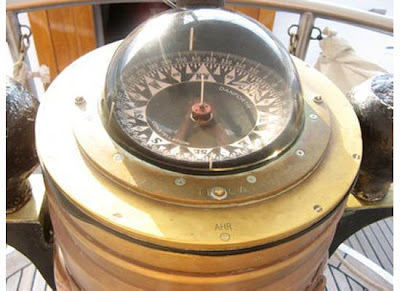
"Uhhh two nine zero but I was just at two seven five a moment ago and I'm trying to get back there." Obviously the coy numbered sphere bobbing in a glass dome of water is culpable yet somehow the blame is always put on the helmsperson with a tiny portion set aside for finicky winds and currents.

The compass, suspended in liquid to account for the boat's constant motion, turns its body to face magnetic North. A thin, white, cylindrical magnetic strip sticks up from the spinning black hole, remaining constantly firm in the middle of the doghouse doorway and determining the gravity of my errors. The numbers she reads are not even entirely reliable, since I have to convert from magnetic to true North before I plot our dead reckoning position on a chart. Still though, I stare at her unblinkingly for the allotted hour until I, relieved, am relieved.

The mate stands beside me and tries to give me tips, ones I have heard many times before. Wait twenty seconds before correcting again. Do not correct more than five degrees. Watch the bowsprit, mainmast, wind, current, JT sheet, birds, clouds, wave bubbles. Begin steering the other direction before the boat is done turning. Let Cramer steer herself. See what direction the boat is leaning and put the rudder a bit in the other direction to even out the course.

But the moments in which I am steadily on course are not due to these tactics but simply because the compass has decided to be generous. She taunts me, making me feel like I have finally mastered the helm and staying on course for just enough time for me to think it is safe to drink some water or adjust my ponytail. Then without warning I am off course and frantically pleading.

What a conniving little bitch! I have done nothing to deserve this.

Helmsperson is the position of most obvious power on the boat. The fate of our direction relies on the innocent helmsperson and this small object, which travels from 000 to 360, glorified on its own pedestal. I loathe its tick-marked, white numbers and the triangles that signify the direction points. I loathe the way it dances mockingly before me. I loathe its minion of luffing sails, banging sheets, clanging jiggers, screaming winds and boisterous currents. Even after eighteen years living in Brooklyn, I have never encountered a more terrifyingly powerful gang.

Before embarking on the SSV Corwith Cramer I joked that there was a strong chance I would be responsible for the boat hitting an iceberg. "But you're sailing in the Caribbean," my friends would remark. "There is no ice there."

"Exactly," I would respond.

Now that I am finally sailing, it is no longer a joke. If we were to end up in freezing waters, I would not be surprised. And it would all be the compass's fault.

But I was just at two seven five. I promise!

My Personal Coffin

My bunk is located on the port side of the SSV Corwith Cramer, the upper and most aft of the six cubbies. Initially I regretted calling this hole my home because of its location in the noisiest part of the boat, the main saloon, where people congregate to eat their meals and talk. In addition, there is no easy way to get into bed since I am a mere five foot four inches. However it is time to reassess this glum logic from thirty days of yore.

1) I hardly ever miss a meal. The galley workers really know how to turn canned produce into excellent food and meals are a great chance to catch up with my shipmates.
2) My bunk is tall enough for me to be able to put on pants without having to lie down like most of my other shipmates.
3) There is a fan inches away from the bottom end of my bunk. Though it blows cool air directly parallel to my bunk, if I dangle half my body off the bunk I can sleep comfortably.
4) Comfy red settees line the edges of the main saloon, including the area right below my bunk. This is convenient for relaxing as well as for when members of A watch come to wake me up. JP or Anna stands on the settee, which allows for optimal hearing and more satisfying wake ups since I can see the face of the person waking me.
5) The lab generator switchbox, located inches away from the top end of my bunk, hums to let me know when science is happening.
6) The water pipe running through the side of my bunk allows for extra hanging space. Along with the wooden pole located outside my bunk for vaulting in, I use the water pipe for damp laundry.
7) My bunk has shelves instead of nets or large, empty spaces. Ideal for organization.
8) The main saloon is centrally located which provides me with superior situational awareness.
9) The only smells are cooking and baking aromas. No greywater stench, head odors or engine room fumes.
10) Six other shipmates share the main saloon as a living space--Maggie, Heart Break, Sarah Sarah Dixon, Beta, Anna and Di--which makes it more entertaining than other spaces on the boat.
11) There is ample room both in my bunk and in the main saloon. Chances of me smashing into something are slim, though that does not mean I don't lose my balance multiple times a day.

Though I am fond of my bunk, I do not enter my space unless necessary. This is due to my aversion to being alone as well as my dislike towards the musty smell. The red curtains, thick enough so that I can change without shame, retain all heat within the small box. It has taken some practice but I can vault into my bunk without bruising my shins, a feat I am proud of. And now six hours of sweaty sleep await me and I look forward to curling up in the dank, yellowing polka dots of my soft mattress until JP sings my name repeatedly or Anna shines a light in my face and yells TRUCK!