Drive the Game

Life in Kenya is not a rerun from a dramatic, possibly staged television series on the savannah. Looking out the van window, I would fail to hear a British narrator and urgent instrumentation over the trumpeting of an elephant herd or the galloping of Grant’s gazelles. When six hyenas bombarded a pack of African wild dogs, running off with their mangled carcass, all I heard were the breathy curses of my classmates.

For such a remote wilderness, the fast paced lifestyle is remarkable. Whenever we would receive a radio alert about a rare, endangered, or elusive animal, we would dash to the van and drive. With only thin dust roads showered with pebbles, speeding is safest. Swerving off into the brush after an aardvark or honey badger hardly impacts our ride.
That night, I had just finished a pre-dinner bucket shower, using a friend’s leftover hot water. Upon emerging from the hut, I noticed the van’s headlights on. Afraid I had forgotten about a scheduled game drive, I grabbed my fleece jacket and hurried into the van, with my professor, Dustin Rubenstein, at the wheel. The radio call was for wild dogs, which seemed dull to me. Dogs are not exotic mammals, and it is not surprising that the ones in Kenya would be wild. But I decided to give them a chance, so I zippered up my jacket and climbed up to the crevice between the van’s trunk and the raised safari roof.
Beyond the three electrified fences that contain the campground, Mpala is indistinguishable. Locations and directions require careful consideration, such as “by the stagnant pool where hippos sometimes bathe,” “that place where we saw the lion yesterday” or “near the abandoned air strip”. But animals move. This came as a surprise to me since I had been treating Kenya like a zoo. I travelled to the equator line to observe animals, most of which I could gaze at from behind double paned glass. At a zoo, a desire to observe wild dogs would lead me down a nubby carpet to the wild dog area. Kenya has no wild dog area.
The sunlight fades fast on the equator. Brightness does not linger in the clouds; it shifts from a clear white to muted gold to dusty red to black. As the atmosphere transitioned from gold to red, illuminating the dust particles that will soon adhere to my skin, we began shouting out the window at passing drivers, “Excuse me, have you seen a pack of wild dogs around here?” Some shook their heads, probably too engrossed in their research niche to worry themselves with another species, and others emphatically carved a route with their arm and urged us to hurry.
Dusk turned to night, and we took turns scanning the roadsides with a handheld spotlight. Since this meant that we could only see one side at a time, our paced slowed considerably as we surveyed the ranch. The spotlight danced as the van clambered over pebbles. Sitting on the roof disqualified me from holding the heavy spotlight and I was thankful for the lack of responsibility. The dogs could be on the left with the shaky circle of light on the right and we would keep driving forward.
Luckily this fact was inconsequential because the van’s headlights climbed the body of a wild dog from paw to rounded ear. Too stunned to react, Dr. Rubenstein did not stop the van until the whole pack felt the heat of the glare. A limbless crimson dik dik carcass lay glistening in the road. Six wild dogs, resembling regal German shepards with long, copper fur spotted with black and grey, gnawed on the dik dik torso, while thirty waited behind them eagerly. The motor, purring like a cheetah, did not faze the grazers but the vigilant ones turned their heads away from the fracas.
In that instant, six hyenas ransacked the scene with one, flanked by an entourage, swiftly grabbing the carcass in its jaw and rushing into the nearby bush. The wild dogs, so accustomed to the warm treat, looked at the bush, bewildered. A few nosed the road, coating their bloody snouts in dust. Some ran to the edge of the bush, barking. One snarl from a hidden hyena sent the whole wild dog pack trotting down the road.
The headlights and spotlight soon revealed nothing more than mika-speckled rocks. I heard bones cracking somewhere to the left of the van, but the verdant shrubbery concealed the ugly, snarly faces of the victors. The sound of shattering ribs verified the bandits as hyenas, since their teeth uniquely allow them to pulverize bone. Hyena feces are distinctly white in color as a result of this trait.
Where did the hyenas come from and how long had they been there? It seemed that we were the missing link to their master plan. We made it known to the humans we passed that we were looking for the wild dogs, but how did the hyenas know to distinguish our van from all the other ones? Either they followed our rattling van to the meat or had been waiting lazily for a random distraction.
The wild dogs went hungry due to my curiosity. Human interference makes unknown impacts. We noticed the hyenas because as a group of biologists-in-training, we collectively notice every stick bug and chameleon. But maybe every van interrupts natural behavior. Maybe every ecological experiment disrupts instead of protects. I never knew innocent intentions could be so cruel.

bella horrida bella (wars, frightful wars, Aeneid XI.86)

Ants have been regarded as model organisms due to their small size, short generation time, and the lack of guilt researchers feel in manipulating them. What I did to those four species of acacia ants that I studied in depth with Columbia’s EEEB department (ecology, evolution, and environmental biology) in the Laikipia District of central Kenya would be a moral and legal fiasco with most other organisms.

Unlike honey bee attacks, all ant species that occupy the popular Acacia Drepanobulum trees can bite and bite and spray all the chemicals they store in their small abdomens with reckless abandon. These pungent liquids, pheromones, symbolize heterospecific and conspecific aggressive behaviors, meaning that ants engage in civil war as well as international war when threatened.

I posed an obvious threat to these ants. Roaming through a forest of various acacias, I searched for specific color combinations: red-red-black (Crematogaster mimosae) and black-black-red (Crematogaster nigriceps). From half a petri dish, I created a battle arena and disproportionately placed the same species from different trees as well as different species, timing how long it took them to kill each other.

Before the battle, I had to verify that the enemy was indeed the enemy by sending a sample victim into the “home” colony. A tangle of writhing black substituted for passport identification. But beyond smelling enemy pheromones, do varying defense behaviors exist?

I knew the answer was yes even before I began my vicious permutations. I tapped an acacia branch until the ants left the comfort of their enclosed habitat, bulbous brown swollen thorns, to investigate my attack. Positioning the two sides of a petri dish like hinged jaws, I then proceeded to engulf ten samples. If I counted less than ten, I snapped again.

“Pain is temporary,” I reminded myself as ants escaped my gutless plastic monster, rioting on my forearms. I murdered more than I imprisoned. Maimed ants were flicked away for fear of faulty results. Both species bit with equal ferocity and impressive alacrity. They shimmied up to my neck and squeezed down to my toes.

Though I did not have access to a wet lab, I detected the release of defense pheromones. I could not see them in the battle arena but I could smell them on my own skin—an acrid and moldy stench, like mixing wet leaves with used running socks.

Given their retaliation towards me, I expected similar brutality when faced with an intruder ant, which I shoved into a petri dish of its enemies. But for every kind of enemy—C. mimosae of one colony versus C. mimosae of a second colony, C. mimosae versus C. nigriceps, C. nigriceps versus C. mimosae, C. nigriceps of one colony versus C. nigriceps of a second colony—the ants employed a different war tactic. In what can be dubbed an act of brotherly love, the acacia ants exhibited a faster and more frequent heterospecific response than conspecific response. Ants of different species became nothing more than eraser rubbings rolling around the petri dish. Ants of the same species but different colonies were sometimes killed, sometimes pardoned.

In the aftermath of ant war, there was no blood and no guts. A few shriveled black specks like squashed soda cans did nothing to elicit any emotional response. My emotional response came when, after believing my hypothesis to be correct, I ran statistical chi-squared and wilcoxon tests of my data and found that there was too much variance to have conclusive findings. I could spend another day in the field collecting more samples, I could revise my experimental design by grinding up the different species into a PETA-disaster-paste and covering the ants in enemy pheromones, or I could admit my lack of dedication and stare at the less belligerent drongo birds.

That night, kicking off my brown coated clothing, a few ants skittered off into the corners of my tent. Briefly checking for ticks and sunburn and remembering with surprise to swallow a malaria pill, I immediately fell asleep. The dreams of a researcher sting with the bites of Crematogaster acacia ants.

Best Behavior

In 1920’s Paris, with trails of white smoke curving from dangling cigarettes, artists and writers discussed their work, speculations, and mental blocks. At the Mpala Research Centre in central Kenya, with trails of red dirt curving from the laboratories, biologists and chemists discussed their work, speculations, and experimental design.

A tourist, dressed in khaki adventure shorts and a wide-brimmed sun hat, would likely gasp dramatically at zebras munching on long, green grass and then drive on to more discoveries. As a tropical biologist-in-training, I dressed in quick-dry pants and a long sleeved rashguard, urgently pressing a stopwatch before staring at a Plains zebra (equus burchelli) through binoculars for five-minute trials.

Dominant behavior is most evident among harems with an alpha male and docile, hungry females. Along with eating, watching for predators is necessary for survival. The amount of time females devote to nutrition depends on the size of the group. A bigger herd size should indicate more vigilant animals, increasing the overall time spent feeding. After five minutes of constant staring, images of a glistening hide in brilliant black and white, wet nostrils, swiveling ears, and a tail flicking at flies no longer register awe. Written in the waterproof pages of a researcher’s notebook is Trial 7, with tallies marked in their allotted columns.

Plains zebras, prevalent when I had searched for honey badgers or aardvarks, seemed to have vanished into the thick acacia brush when I really needed them. Impala, Thomson’s gazelles, dik diks, hartebeests, Grant’s gazelles, orynxs, and other ungulates proudly stomped the red dust into billows but the—Oh, are those them? No, Grevy’s zebras. Keep driving.—locations of my research subject could not be found. All the animals in Mpala have their unique hangout spots, but they are not as certain as a zoo enclosement. The Plains zebras have no sign with arrows and exclamations, no address. So many questions to ask the landscape: the mountain ridges fading into increasingly paler shades of blue, the corpulent swollen acacia thorns, the lickerish baboons and dainty klipspringers. But I have chosen to ask the Plains zebras.

The red dirt clung to my sunblock and eyelashes as I gazed out into the lush fields. I envisioned stripes between tree branches or a whishing tail in a low flying drongo bird. I even tried to castrate bachelor male herds with my desperately determined mind so I could include them in my study: the relationship between herd size and the time females spent foraging or vigilant using focal and scan sampling.

Grazing female zebras chew with their heads down, focusing on the blades tickling their black snouts. Vigilant females stare up at me, the menacing intruder clutching a sharp pencil. “Down!” I whispered at the grazing ones. “Up!” at the vigilant ones. As they oscillated between nonchalance and terror at my behavior, I calculated time and begged them not to flee.

After a day of 140 trials, I returned to calculate what turned out to be inconclusive results and eat dinner—green lentils, white rice, and chapattis, a thick fried dough. As I tilted my head down to my plate so the rice wouldn’t fall off my fork and lifted up my head to chew and listen to fragmented conversation, I reasoned through possible error sources: habituation time too short, large variation amongst the trials, observer’s delirium. At that moment, a group of zebra may have been peering at me, balancing binoculars on their muddy hooves. In the cacophony of insect night life, I could almost hear them snorting “up” and “down”.


On the Road...

...to university fame (kidding). The most recent post on this blog, "Market Hunting," was accepted into Surgam, one of Columbia University's literary magazines. An excerpt can be found on the Columbia University Arts blog:

Market Hunting

You plan to go to the market, not because you need to buy something but because you need to be reminded why you are in Vietnam. Last night you went to an expat bar and spoke English while dancing to Lady Gaga. You spent the morning reading about economics in English and texting American friends. With half an hour until lunch, you have almost enough time to escape the bubble and walk.
You close the tall iron gate of the pastel yellow French colonial house, a skinny, miniature version of the French equivalent, and walk past the badminton courts at the end of the residential block you always tell taxi drivers is yours, and where your Vietnamese family of two months lives. It is a lie, since your school pays these people every month and you have no biological relationship, but you can pretend. Today you don’t need a taxi because the market is in your neighborhood.
Hanoi is so oppressively humid that after a while your body does not register the heat; sweat glands work as they should, and no one judges the sweat stains on your elbow-length conservative shirt because everyone’s clothes are damp. Your sheets are damp when you wake up, your toothbrush is damp, the seat of your chair is damp, your damp notebooks are crinkled, your damp computer screen has spots of mold, your damp thighs slide together when you walk, and the steam rising from three hot meals does not fog your already fogged glasses.
Trees line your street, which is rare for this city, but you are confused about where these trees are actually planted, since looking up, all you see is a tangled mass. Green leaves connect to branches and green leaves connect to bundles of suspended electrical wires. Your knowledge of technology is limited but you are fairly certain those clumps of wire should not touch the way they are touching, especially since they are all so damp the copper has probably turned green like the Statue of Liberty. Each wire has a person and story on the other end but no one cares enough to make it straight. Maybe it is hopeless, you think. You try not to be ethnocentric but it is difficult.
Your street goes in a loop, not a grid, and the market is four blocks away to the left yet still bears the same street name. Hanoi’s haphazard plan does not bother you because at least it does not give you rashes or ruin your possessions or require three cold showers a day like the temperature. You walk with alacrity, your spongy black flip flops pattering to the beat of your gait, to show the Vietnamese couples staring that you are not a tourist—you know where your market is and how to get there. Having passed it every morning on the way to school, you know what to expect but today you decide to visit the stalls you ordinarily purposefully avoid, to get a zap of culture shock.
As your neighbors stare, you smile demurely and pretend this is all natural. Really though, your heart is pounding because it always thu-thumps with every motorcycle screech. Crossing the street, you get so close to the speeding drivers that you can see the labels on their jean waistbands—another fake Dolce & Gabbana. One day your white skin will be so distracting, the driver will not swerve. It happened once already, the teenage male driver with black hair gelled in spikes staring at your blue eyes with startling intensity, face frozen, but you ran across the cracked asphalt when you noticed his hands neglecting to reach for the hand brake, and your damp thighs slid together while you sprinted as the safety of the next crowded street approached.
The vendors cover some of the sidewalk slabs with heaps of used clothing and handbags so that you must retreat to the stream of Honda Dreams and Vespas with their shrill beeps, a Morse code that lets other drivers know their presence on the asphalt. The system is not foolproof and you have seen the evidence—battered metal and dazed, bloody Vietnamese men discarded on the side of the road. You have never seen even an indication of an ambulance, but you have learned that sometimes it is better not to ask questions.
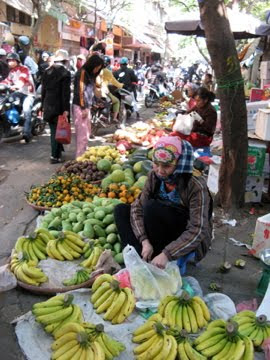
It is better, also, not to ask how much something is. You enter the outdoor market through a narrow oval entrance in an alley wall lined with red bricks and are bombarded with the magenta, red, orange, lime green, deep green, and pale yellow colors of the fruit vendor stalls. Nothing has a set price because not even the price of dragonfruit is predictable. Instead you call out numbers, easy vocabulary, until an agreement is made. At first this was a fun game but because you are foreign, you are also wealthy, since one American dollar equals twenty thousand Vietnamese dong, so the game has turned guilty and panicked. The prickly scarlet balls of rambutan and the scaly pale green custard apples remain in their straw woven baskets and you continue onwards.
The phở smells like basil and the roasting chicken smells like a summer cookout. Oil crackles on portable gas stoves and Vietnamese families perch on small blue and red plastic stools, shoving noodles and meat into their mouths with chopsticks. The fragrances mix with smoke, making the moist air even thicker. You turn a corner and the lunch becomes raw. Gutted dogs lie on sticks ready for the rotisserie. Shelled sea urchins glisten in a heap. Bloody pig limbs rest in rows on a counter: slabs of meat, hoofs, and intestines. Silent, the butcher stares forlornly at the customers intently weaving through the vendor stalls.
A porcelain bowl of fat wiggling maggots is displayed on the curb and the vendor absentmindedly picks her nose. A cage of indignant roosters is tied to the back of an abandoned motorcycle. The birds screech at the discomfort, ignorant of the fact that soon they will be butchered, defeathered, and then plopped into boiling broth. This immediacy of your meals unsettles you, realizing that you prefer the anonymity of hamburger patties and chicken cutlets. Ducking under a blue tarp to evade the blinding sun, you discover another maze of stalls.
Withered frogs are displayed like sheets on a clothespin line, noodles on the floor in a dusty corner in twisted bundles like hay. Some vendors smile at you as you wander, but most stare blankly. Customers push past one another, competing for the competing vendors. Around another corner are plastic stickers and toys of animals, blonde dolls, and Ho Chi Minh. Further down the street are boxes of fake paper money and buckets bursting with bright flowers you can’t name. Each area of the market has a special purpose, from offering a meal to providing funeral décor. The market is the order in your chaotic Vietnamese life. This ancient system seems to work for the citizens, though economically speaking, you are stumped, since compartmentalizing the market heightens competition while demand remains constant. But you are not part of the system and regardless of what you say, you are not a citizen here and will never be.
Passing each middle aged woman selling identical flowers side by side, you notice lacquered bowls and vases across the street. You consider buying a lacquered item because of your newfound obsession with the haunting depth of the shiny, metallic technique but decide to wait until you are about to leave the country to stock up on appreciations. The Vietnam National Fine Arts Museum dedicates an exhibit to lacquer art and slowly meandering the dimly lit hall for the first time of many visits, the dark red and inky black tones make you quiver in the air-conditioned French villa, incredulous at the meticulous detail and the complex process necessary for lacquer technique. A cobalt vase gilded in gold perched on the market sidewalk curb glints in the sunlight and you look down at your toenails, newly painted with bright red glitter.
The market vendors are much less aggressive than the teenage vendors that wander the city streets with a box awkwardly dangling from their shoulders, selling scarves, postcards, and cigarette lighters. Market vendors shout at customers, customers shout at vendors, vendors shout at vendors, and customers shout at customers. No one shouts at you because you would not understand and do not belong in this market with the buzzing flies and whimpering dogs, scraping spoons and screaming children.
You are a woman, so you are at the market. Yet everyone sees through the lies. You weave through crowds and haggle persistently but you will never be a woman casually walking through the market. You will always be the girl whose knee length skirt is just a little too short, who slips in the trash that litters the curb, who takes pictures of anonymous houses because of a fascination with the foreign architecture, and who confuses the words “beef” and “father”. One morning last month you tried to ask your host mother if it would rain that day, she nodded, and you brought an umbrella to school; later that day, she was surprised to see you home because you had told her you were going shopping.
Passing a humming refrigerator stocked with local beer, you want to buy a sweating can but are unable to because your male friends are not here to buy alcohol and energy drinks and anything considered unfeminine for you. Your host sister calls them your bodyguards and coyly smiles when you assure her that you are not dating any of them.
You came to the market to be reminded of why you are here. You turn to retrace your steps because instead of finding the answer to your question, you encountered other people asking precisely the same thing. You walk at your brisk New York City pace now, not pausing to look at the pearl necklaces or t-shirts, yellow chicks or slowly scrambling turtles, gummy candies in the shape of Hoan Kiem temple or rainbow lollipops. You need to be home in time for lunch. You hope for tofu or summer rolls but it will probably be something involving grease in the hopes of fattening you up to make your American parents happy.
A group of middle aged, pajama-clad women perform vigorous arm thrashes, hops, and lunges in the badminton court at the end of your street. You have often seen Vietnamese adults engaging in this activity, and have never figured out what it is. The exercises remind you of tai chi on acid, or watered down aerobics. The Vietnamese value exercise but your host sisters hate moving, especially when it is hot. You were not aware that people could dislike walking. Because of their sloth, you feel like it is possible you are related to this Vietnamese family.
Except that you cannot be part of the family if you don’t have a key to the house. You ring the doorbell and scratch at a mosquito bite as you wait for your host mother to emerge from the kitchen. You beam and wave excitedly. Your host mother does not return the sentiment. She opens the door and asks you, “Cháu có vui vẻ tại thị trường? (Did you have fun at the market?)”
You pause, making sure your interpretation is correct before you respond, nodding, “Văng (Yes)”. You are glad you are home, though, and just in time for sweet green banana and snail soup, steamed white rice, garlic beef stir fry and spring rolls. It could be worse, you think, and help set the table.

Surviving Spaghettification in Space

The universe consisted of a compact ball of hydrogen (protons, neutrons, electrons and their anti-particles) plus radiation. There were no differentiated planets, suns, stars and galaxies. Five billion years ago, the compact hydrogen soup blasted apart with huge force, matter was hurled in all directions, and the universe doubled in size.

The blast caused a major decrease in the density and temperature of the universe after which new particles could be formed. Then the particles and anti-particles fought in a frenzy of self-destruction. The universe was left with a greatly reduced collection of positively-charged nuclei and negatively-charged electrons in a vast plasma mass.

Ninety nine percent of the matter of the universe still exists in this plasma state. We perform our own version of the big bang theory. We are all made of stardust—carbon, nitrogen, and oxygen. We smash up against each other for victory, slushing through a plasma sludge of our own making.

Stars are in constant battle with the pressure of gravity. When stars succumb, black holes form. Light is emitted when black holes collide. If something falls into a black hole, it gets stretched and shredded: spaghettification.

The sky looks like celestial soup without overbearing light pollution competing. The pale yellow dots splattered across a black bowl are overwhelming. Stars only twinkle. Do not flash or sparkle. It is bizarre for something to only be allowed a single verb. Though the dance implies movement, stars are not living beings. Do they listen to music? Is there a synchronization we are not aware of? They show up for the performance every night. Their enthusiasm never wanes, even as the sun, ruler of stars, threatens to overtake them.

Stars are so highly complex yet their beauty is so simple. They are there every night, regardless of whether or not I can see them. Their presence is secure in the world of chaos, though the realm in which they float is more chaotic than the busiest city.

I dreaded college in the city because I had always envisioned college filled with trees and grassy quads, with a multitude of students perfectly proportioned by ethnicity playing Frisbee on a forever autumn afternoon. No stargazing with friends splayed out on the lawn after a night of drinking games and dancing to Beyonce and Jay Z.

But I found beauty on the roof of the astrophysics lab building one night, peering through a telescope and counting the four moons next to Jupiter—Europa, Io, Callisto, Ganymede—and then looking over the ledge of the roof lab over the library to the blinding skyline with the bright speck of Jupiter and a waxing crescent moon suspended over a fluorescent Empire State building lit red and blue.

The first time I saw stars, I was eighteen years old. Having escaped an attempt to play the drinking game Kings with two decks of cards instead of one, I was lying supine in the pebbly sand of Woods Hole, Massachusetts, as a friend pointed out my first constellations: Orion, Taurus, Cassiopeia, Ursa Minor. I listened to the ancient stories, speechless. There were so many of them, dancing rhythmically to the sound of ocean waves.

Orion the hunter has three diamonds on his belt, aiming to kill Taurus, three dots in a triangle. The bull was a disguised Jupiter, who abducted the naïve and unsuspecting maiden Europa. Cassiopoeia twirls around in her throne as punishment for declaring herself the most beautiful. Arcas, who almost killed his mother and was transformed into a little bear, looks more like a small ladle.

Stars are highly complex yet their beauty is simple. They are there every night, regardless of whether or not I can see them. Their presence is secure in the world of chaos, though the realm in which they float is more chaotic than the busiest city.

I float on the frothy surface of chaos, a space cadet. There are moments the tide pulls me under and gasping for breath, my heart pounding and my head spinning from lack of oxygen, I am tempted to succumb. But the waves eventually spit me back up and I evade the threat of black holes.

I used to twinkle incessantly; now I just try to stave off gravitational pulls.

Science has taken advantage of my admiration for it, controlling my decisions and letting me sacrifice so much in its name. I refuse to be spaghettified by physics and chemistry. Numbers drive me now. I have chosen language that I can hear and almost taste, history with artifacts and proof, words I am able to visualize and create.

Stop.

Stop memorizing adrenocorticotropic hormone, compartmentalization, primary streak, mycorrhiza, apoptosis, nonsense codon, epididymis, Schwann cells, Casparian strip, loop of Henle, sarcoplasmic reticulum, corpus luteum, trophic cascade, imbibition.

Eclipsing binary, perihelion, inferior conjunction, geosynchronous orbit, protoplanetary disc, hypergalaxy, Roche limit, supernova, heliopause, Oosterhoff group, Cepheid variable, magnetosphere, entropy, toy theory, globular cluster, dwarf planet, chaos, spaghettification.

Adrift With Virgil

The water looks like it is covered with a film of cellophane and I could pop a swell bubble with a large needle. The ship creaks and metal jiggers clank lazily against the masts. Thick, coarse sailcloths slap and whisper in the faint breeze, which does little to alleviate the oppressively humid air. The soft grainy wood of the quarterdeck sticks to my flushed skin, and when I lift my calves, the dark grey imprint of my sweat remains on the planks. Sunscreen trickles down my back in white squiggles and my attempts to shield my bare shoulders from the sun are in vain. The sticky lotion oozes between my fingers as I smear sunscreen onto my freckled nose and over the prickly stubble of hair on my legs. Salt from my seawater hose showers and evaporated sweat sticks to the sunscreen in sharp, gritty crystals.
My favorite sound is the ocean but the sound disappears when there is no wind to make waves. The ship rocks slowly from side to side, port to starboard. I relish my ability to walk the 134-foot distance steadily, and this momentary hiatus allows my mottled bruises time to heal. I bang my shins vaulting into my bunk; my elbow is pink and puffed from hitting the belowdecks support column every time I pass the two gimbled tables swaying and laden with platters of burrito toppings or fresh bagels or glistening tomato soup; I stub my toe whenever I lose my balance in the laboratory; my cheek bone is still purple from the unexpected swell that knocked me forward while I was counting zooplankton under a microscope to estimate their population frequency; the bandaged scrape on my calf from when I fell through the bowsprit net while furling the JT threatens infection; and my hip has a large blue-grey tinge from when I fell into the oven handle while trying not to burn scones, which were thrown overboard anyway because I had distractedly added too much baking soda.
I am drifting somewhere in the North Atlantic Ocean, sailing on a two masted brigantine with nine cream colored sails I have set and struck, with two dozen lines I have hauled and heaved. A confetti of zooplankton and eroded plastic pieces skim the waves. Dolphins play in the frothy bow waves and sometimes their slippery, leathery skin becomes coated with the confetti. Belowdecks, the glossy wood-lined box with dusty, moldy maroon curtains where I sleep traps the hot air, making it difficult to breathe and resist the urge to tear my clothes off. No amount of fatigue makes a nap bearable in these conditions, and though typing on a steady computer screen in the library without swirling water darkening the porthole seems like a viable option while hovering in the entrance to the corner alcove and listening to the drone of the engine room next door, I decide to wait until sunset.
When I feel my days losing direction, I bring The Aeneid with me to the quarterdeck. The pages are folded and yellowing, the highlighted and annotated marks in orange, green and purple are blotched from spurts of seawater. The blue cover has detached from the text from too many affectionate readings. I am up to Book Four, having already read descriptions of Aeneas being tossed in Neptune’s waves as the Sargasso Sea has tossed me. Book Four details the frustrations with rigid plans. Aeneas just wants to continue having sex in caves with Dido. Rome can get founded another time. The sea has become a chore for Aeneas. The sparkling waves never change.
“I’ll be up all day,” I moan, letting my head rest on the edge of the quarterdeck hull. I close my eyes and sigh. A brown booby flies diagonally from broad on the starboard beam, diving to snatch helpless zooplankton from the flat surface of the sea. No waves propel the zooplankton or hide them from the enemy. Perhaps the booby is a disguised Mercury, sent by Jupiter to cajole us back to vitality. The minute hand jerks to twelve, a shrill ring reverberates through the quiet still air, and order is restored. A shipmate on watch leans over the rail of the opposite hull and peers at the taffrail log. “Great. 632.8 nautical miles,” she exclaims, crouching into the narrow doghouse entrance to record the result on the sprawling, faded map of the pastel blue Caribbean Sea, smudged pencil calculations of where we think we are, based on measurements of the sun’s position. In the last hour, we have sailed less than half a mile.
I could use a shower but fresh water is a rare commodity and today is not a Shower Day. Today is the day I write the discussion section of my oceanography research paper on the accumulation of plastics on Jamaican and Dominican beaches. Today is the day I finish my ethnomusicology paper on Dominican bachata music. Today is the day I don’t vomit over the side as saltwater stings my eyes because the wind died just when we all predicted it would be strongest. I had elected to sail for two months in the North Atlantic Ocean to appreciate the sea and stars, and to understand the historical hardships from Odysseus’ and Aeneas’ divergent journeys, to Columbus’ accidental discovery of America, to the calamitous 2010 earthquake in Haiti, but I am relieved every time conditions keep us from sailing, instead forcing us to drift aimlessly. As a native New Yorker, I rarely experience idleness.
Science textbooks on polished, wooden shelves line the white painted walls in the cramped furnace of the belowdecks library, secured with lines of frayed blue bungee cords. A large, white plastic fan with ELVIS KING scribbled deliriously in sharpie blows hot air at the textbooks like a hairdryer, fading the green and blue hues, and completely disregards the college students dressed in Patagonia tank tops and Billabong bathing suit bottoms with wispy hair coated in salt and oil, puzzling over Excel graph data. The books are never removed and opened. Instead, I address questions to scientists with PhDs or peer into buckets of net tow samples and petri dishes of sieved marine organisms. This is what science should be. Science is not fifty pages of small print or one hundred multiple choice questions. It is not a factor of my GPA, it is the adventure of gybing on a port tack to prepare for a Hydrocast deployment, and the surprising discovery of eighteen degree mode water in the Yucatán channel.
Science surrounds me, inescapable as Aeneas’ destiny. I watch my fatigued shipmates clamor to action at the sound of the hourly clock chime, measuring Beaufort force, wind and current direction, wave height, temperature, salinity, fluorescence, depth, and direction. Direction is the most difficult concept for me, much more than spectrophotometry or the principles of buoyancy. I steer off course more than on course and on slow days with no wind, it is just as hard to control the helm on calm days as on days when screaming wind tears at the sails and water splashes up one hull, slapping the opposite one. Juno should not feel threatened by me and I cannot comprehend why she would change the currents to lead me astray. “Forty degrees off course,” I call out in exasperated warning as per protocol.
While Aeneas can accuse Juno and the Fates for his misery, I alone am to blame for my wandering. Plans and directions are comforting but the strong pull of currents leads me astray to two hundred degrees off course. I am distracted by shiny possibilities like the phosphorescent esca in the central filament of an Anglerfish. I took a year between high school and college in order to explore and experiment, but unlike those in high school and college laboratories, these experiments are new and tactile. The samples I count are zooplankton that I snatched myself from the ocean at various precisely measured depths, killed with specific chemicals, and recorded according to standard procedure. The chlorophyll-a and the dissolved oxygen analyses I perform disturb beakers of the very seawater that envelops my floating home, the same seawater that abruptly soaks my clothes, soothes the urge to cut my hair when I stand under the fire hose, and cleans my laundry.
Neuston net tows glow at night, parading bioluminescence. After watching the net for half an hour, adjusting the boom to make sure the prized net is comfortable, I hoist it back on the lab deck. My hand reaches for the white plastic jar at the end—the codin jar. Unscrewing the jar fills me with the same excited anticipation as when I first translated the final lines of Book Twelve from Latin to English. The zooplankton is a slippery mass of pink goo, flashing neon green in flickers. A Sargassumfish wiggles through a chunk of beige, scratchy sargassum weed and a small seahorse lies motionless on an unidentifiable piece of red plastic. Though there is no indication of human life beyond the ship except for the occasional traffic threat two points off the starboard bow, signs of human destruction hover in the pelagic zone, waiting for innocent students to collect and count plastic shards and oil pellets.
I appreciate the discomfort that study abroad brings because as humans we rely so much on convenience. It is easier for a tourist to flick a cigarette a few inches from her beach towel than to walk to a trashcan. Jamaican locals would rather toss condoms and crackling food wrappers to be swept away into the ocean by wind. Dominicans dump cracked fishing crates and broken computers directly onto the sandy shoreline so they do not have to roam the streets searching for an evasive dumpster. The hopelessness of the situation, and the thousands of debris fragments I systematically collected from six tourist, local and unfrequented beaches, and fished from the surrounding turquoise Caribbean waters, is discouraging. Of course, because I am an indignant teenager, visions of torn, swollen diapers and black plastic bags studded with slate colored barnacles fill me with inspiration to save the world by majoring in environmental science—Two years of chemistry? No problem!—and restore the solid waste management of the negligent. Aeneas always put the care of his country before the convenience of remaining with Creüsa in Troy or lingering in Carthage with Dido.
The crewmembers on watch duty and the crewmembers woken from their naps join me for the daily two-hour lecture on the quarterdeck, the abrasive tar caulking between the heated planks inflicting burn blisters on the weary students. In the 105 degree Fahrenheit haze of misery, my hands and feet have broken into an itchy, puffy red rash from lack of sunscreen care. Someone tosses me a bottle of SPF 90 and I gratefully squeeze another coat onto the layers of grime that cover my sticky skin. Being allergic to the sun requires me to be constantly alert even when I am not responsible for ensuring the ship’s safety during watch duty. The sweltering air tempts my mind to wander and I have forgotten to hydrate again. My orange Nalgene bottle, scraped white in the places I’ve dropped it to cling fearfully to the rail, holds filtered water hot enough for tea. Considering the thoughts and brainstorms that send me on long-winded, forked roads of tangential mental distraction, I conclude these are not conditions appropriate for beginning a focused two-hour lecture.
Focus. Focus on the dripping sweat tickling sunburned skin. Focus on Captain Steve announcing mandatory Shower Day tonight. Focus on a to-do list of assignments that were put off until the wind returned, even though the threat of seasickness looms. Focus on the glassy translucent water, a vibrant dusky blue. Focus on the mangroves lecture. Focus on the knotty, mangled roots thick with skittering mangrove crabs. Focus on ship report updates. Focus on what happens after we dock in the United States again.
I lack direction, preferring instead to float like zooplankton and let the currents push me places. My friends never know where I am and a coworker once joked that I would soon rule my own island in the South Pacific. But zooplankton, the underdogs, are a crucial life form and one of the most complex and diverse of eukaryotic protists. They rely on the gravitational pull of the moon like Aeneas relied on the Fates, trusting that in the end purpose will be soothingly revealed and their suffering not in vain. The Fates have put me on this stationary ship stuck without anchoring somewhere in the middle of the vast expanse of cobalt blue water. I just hope King Aeolus sends one of his winds soon.