The one hundred count sounds like a marathon or a dietary challenge. In some ways, it is both of these for it requires stamina and endurance, and the seasickness that often accompanies the one hundred count could sell as a weight loss program. In fact, the one hundred count consists of staring at a pile of pink goo under a microscope and poking at it with a sharp metal stick. Highlights include sitting while on watch. Downsides include picking through and identifying tiny zooplankton for an obscene amount of time.
I was almost a quarter way through a one hundred count, calling out the names of the zooplankton I had identified, when I excitedly shouted, "Chaetognath!"
"Really?" the second scientist asked me. Chaetognaths had never shown up on the one hundred counts before. My lab partner came over to the microscope for a second opinion.
"I don't think so, Aliza. Where are the fins?"
"But it's my critter fritter," I defended. "Look at the bristles on its mouth. And it's transparent and clearly a worm." On shore in Woods Hole, Massachusetts, I had studied the chaetognath as my assigned zooplankton and finally seeing it under a microscope, knowing it had been floating in the real live ocean before it was grabbed by the Neuston net and drowned in ethanol by one of my shipmates, ignited a special thrill and passion for this minute worm that I never knew I had.
This moment was one of those hands-on learning experiences advertised in catalogues--when a tedious homework assignment leaps off the page and lies freshly killed in a petri dish.
Three minutes later, I picked out another chaetognath from the mess of pteropods, siphonophores and copepods. This time no one doubted me. Another tally was recorded next to the chaetognath.
Staysail
I grit my teeth and sharply turn left, jamming the rudder ten degrees to the port side. The numbers continue to scroll right.
Maybe no one will notice. My fingers strum the helm as I consider bringing the rudder to fifteen degrees. The mains'l begins to luff.
"Shhhh!" I jerk my head upwards and glare at the sail. And of course, this is the moment the mate decides to emerge from the doghouse.
"Mark your head?" she asks me.
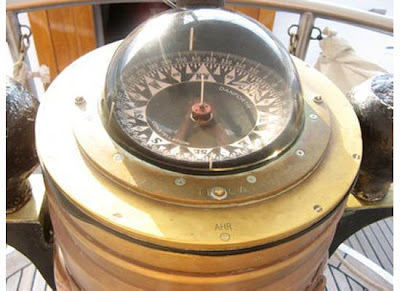
"Uhhh two nine zero but I was just at two seven five a moment ago and I'm trying to get back there." Obviously the coy numbered sphere bobbing in a glass dome of water is culpable yet somehow the blame is always put on the helmsperson with a tiny portion set aside for finicky winds and currents.
The compass, suspended in liquid to account for the boat's constant motion, turns its body to face magnetic North. A thin, white, cylindrical magnetic strip sticks up from the spinning black hole, remaining constantly firm in the middle of the doghouse doorway and determining the gravity of my errors. The numbers she reads are not even entirely reliable, since I have to convert from magnetic to true North before I plot our dead reckoning position on a chart. Still though, I stare at her unblinkingly for the allotted hour until I, relieved, am relieved.
The mate stands beside me and tries to give me tips, ones I have heard many times before. Wait twenty seconds before correcting again. Do not correct more than five degrees. Watch the bowsprit, mainmast, wind, current, JT sheet, birds, clouds, wave bubbles. Begin steering the other direction before the boat is done turning. Let Cramer steer herself. See what direction the boat is leaning and put the rudder a bit in the other direction to even out the course.
But the moments in which I am steadily on course are not due to these tactics but simply because the compass has decided to be generous. She taunts me, making me feel like I have finally mastered the helm and staying on course for just enough time for me to think it is safe to drink some water or adjust my ponytail. Then without warning I am off course and frantically pleading.
What a conniving little bitch! I have done nothing to deserve this.
Helmsperson is the position of most obvious power on the boat. The fate of our direction relies on the innocent helmsperson and this small object, which travels from 000 to 360, glorified on its own pedestal. I loathe its tick-marked, white numbers and the triangles that signify the direction points. I loathe the way it dances mockingly before me. I loathe its minion of luffing sails, banging sheets, clanging jiggers, screaming winds and boisterous currents. Even after eighteen years living in Brooklyn, I have never encountered a more terrifyingly powerful gang.
Before embarking on the SSV Corwith Cramer I joked that there was a strong chance I would be responsible for the boat hitting an iceberg. "But you're sailing in the Caribbean," my friends would remark. "There is no ice there."
"Exactly," I would respond.
Now that I am finally sailing, it is no longer a joke. If we were to end up in freezing waters, I would not be surprised. And it would all be the compass's fault.
But I was just at two seven five. I promise!
My Personal Coffin
My bunk is located on the port side of the SSV Corwith Cramer, the upper and most aft of the six cubbies. Initially I regretted calling this hole my home because of its location in the noisiest part of the boat, the main saloon, where people congregate to eat their meals and talk. In addition, there is no easy way to get into bed since I am a mere five foot four inches. However it is time to reassess this glum logic from thirty days of yore.
1) I hardly ever miss a meal. The galley workers really know how to turn canned produce into excellent food and meals are a great chance to catch up with my shipmates.
2) My bunk is tall enough for me to be able to put on pants without having to lie down like most of my other shipmates.
3) There is a fan inches away from the bottom end of my bunk. Though it blows cool air directly parallel to my bunk, if I dangle half my body off the bunk I can sleep comfortably.
4) Comfy red settees line the edges of the main saloon, including the area right below my bunk. This is convenient for relaxing as well as for when members of A watch come to wake me up. JP or Anna stands on the settee, which allows for optimal hearing and more satisfying wake ups since I can see the face of the person waking me.
5) The lab generator switchbox, located inches away from the top end of my bunk, hums to let me know when science is happening.
6) The water pipe running through the side of my bunk allows for extra hanging space. Along with the wooden pole located outside my bunk for vaulting in, I use the water pipe for damp laundry.
7) My bunk has shelves instead of nets or large, empty spaces. Ideal for organization.
8) The main saloon is centrally located which provides me with superior situational awareness.
9) The only smells are cooking and baking aromas. No greywater stench, head odors or engine room fumes.
10) Six other shipmates share the main saloon as a living space--Maggie, Heart Break, Sarah Sarah Dixon, Beta, Anna and Di--which makes it more entertaining than other spaces on the boat.
11) There is ample room both in my bunk and in the main saloon. Chances of me smashing into something are slim, though that does not mean I don't lose my balance multiple times a day.
Though I am fond of my bunk, I do not enter my space unless necessary. This is due to my aversion to being alone as well as my dislike towards the musty smell. The red curtains, thick enough so that I can change without shame, retain all heat within the small box. It has taken some practice but I can vault into my bunk without bruising my shins, a feat I am proud of. And now six hours of sweaty sleep await me and I look forward to curling up in the dank, yellowing polka dots of my soft mattress until JP sings my name repeatedly or Anna shines a light in my face and yells TRUCK!
1) I hardly ever miss a meal. The galley workers really know how to turn canned produce into excellent food and meals are a great chance to catch up with my shipmates.
2) My bunk is tall enough for me to be able to put on pants without having to lie down like most of my other shipmates.
3) There is a fan inches away from the bottom end of my bunk. Though it blows cool air directly parallel to my bunk, if I dangle half my body off the bunk I can sleep comfortably.
4) Comfy red settees line the edges of the main saloon, including the area right below my bunk. This is convenient for relaxing as well as for when members of A watch come to wake me up. JP or Anna stands on the settee, which allows for optimal hearing and more satisfying wake ups since I can see the face of the person waking me.
5) The lab generator switchbox, located inches away from the top end of my bunk, hums to let me know when science is happening.
6) The water pipe running through the side of my bunk allows for extra hanging space. Along with the wooden pole located outside my bunk for vaulting in, I use the water pipe for damp laundry.
7) My bunk has shelves instead of nets or large, empty spaces. Ideal for organization.
8) The main saloon is centrally located which provides me with superior situational awareness.
9) The only smells are cooking and baking aromas. No greywater stench, head odors or engine room fumes.
10) Six other shipmates share the main saloon as a living space--Maggie, Heart Break, Sarah Sarah Dixon, Beta, Anna and Di--which makes it more entertaining than other spaces on the boat.
11) There is ample room both in my bunk and in the main saloon. Chances of me smashing into something are slim, though that does not mean I don't lose my balance multiple times a day.
Though I am fond of my bunk, I do not enter my space unless necessary. This is due to my aversion to being alone as well as my dislike towards the musty smell. The red curtains, thick enough so that I can change without shame, retain all heat within the small box. It has taken some practice but I can vault into my bunk without bruising my shins, a feat I am proud of. And now six hours of sweaty sleep await me and I look forward to curling up in the dank, yellowing polka dots of my soft mattress until JP sings my name repeatedly or Anna shines a light in my face and yells TRUCK!
The Crameid: Book One
I sing of a brigantine and seventeen students,
Who first set sail from the Virgin Islands;They were not the first on the Cramer,
And will not be the last,
But the Caribbean waters were foreign to them.
From St. Croix to St. Maarten to Samaná, Dominican Republic
They were jostled and pushed by Neptune;
Most leaned over the side of the boat in anguish
As she rolled, but three strong ones--James, JP and Patricia--
Ate their fill of galley delights and lay down, satisfied,
In their cramped and musty bunks.
Tell me the reason, oh Muse, for the bioluminescence
Shining in the waves, almost as a reflection
Of the thousands of stars visible on clear nights.
Or of why there are no phyllosoma in the Sargasso Sea,
Or of how the clewl'n works to strike the tops'l.
How long would it take these seventeen students
To feel confident in their many jobs at sail in the Atlantic,
As a weather reader, a boat checker, an equipment deployer,
A line coiler, an assistant chef, a chlorophyll-a data processor,
An assistant engineer, a writer, a reader, a winkler,
A sailor.
Can such apathy hold the minds of professors?
There was a city they called Port Antonio--
Certainly welcomed by those who could not speak Spanish--
A city situated on the Atlantic Ocean, yet far
From the Dominican Republic from whence they came,
And the United States they think about often.
This land promised information about the Mooretown villagers,
About biodiversity and ecotourism, about reggae and literature.
The people would treat these seventeen students like tourists,
Which they were and were not simultaneously,
And some would feel uncomfortable looking at trinkets
While the island rocked back and forth like a large floating raft.
After adventures in Jamaica, presenting scientific findings
And hiking to marvel at green wonders not seen in the blue ocean
That the students would soon regard as their home,
They would set off on the last leg of their onerous journey
Up the Yucatán and back into the States.
The Captain prayed that King Aeolus would be kind
And offer them a favorable wind at little cost.
Once in Key West, a few would travel with family,
One would go see a space shuttle launch,
One would study for his LSATs,
And the rest would sail together to Charleston.
Just out of sight of Samaná, the students already
Had begun to wonder what would happen after
The Cramer had washed herself of the seventeen;
Would they ever be all together again?
The group had held together just as a copepod clinging to
A clump of Sargassum weed manages to nestle in a groove
And avoid being drowned in ethanol, instead being tossed
Once again back into the sea, a science evader.
Would all projects be turned in on time?
Would the water for the pasta ever boil in the galley?
The students constantly asked themselves questions.
Questions related to anxiety and homesickness,
Ignorance and frustration, curiosity and awe.
Hands to set the jib!
Which one is the jib downhaul again?
Take Me to Zen Yen
He wore a maroon fake Dolce & Gabbana shirt with a white flap on the left shoulder and another white flap on the right breast. His uneven brown hair was carefully combed over his dark brown eyes, which gazed at us four Americans uneasily and with a hint of envy. Meanwhile, we joked around with our friends in the other rowboats, taking pictures and splashing water. And then suddenly, all the boats were gone. That’s when we finally saw the boy struggling to fight the current.
The five of us were totally alone--no sounds but that of the oars dipping into the glittering water, nothing to see but mountains soft with tufts of green trees, tall grasses and pink lotus flowers, and the reflection of the grey and white clouds in the water. The river was ours. The silence was a peaceful break from the smoggy chaos of honking motorcycles that defined our new home, Hanoi.
His name was Trung. This was his first time rowing tourists from the Perfume Pagoda. He was sorry he was taking so long.
I was sorry he was our age, yet had dropped out of school to take us from one unfamiliar shoreline to another. I was sorry his arm muscles did not have enough power to continue rhythmically circling the oars. I was sorry I could not help him.
He would stretch a tired smile whenever we did something silly to amuse him, like singing Santigold or daintily dangling slices of bread in front of his face for him to bite. Otherwise he wore a tight-lipped grim line of a mouth, eyes squinting in pain.
Middle aged women in conical hats streamlined past our rowboat, laughing and teasing our faithful Charon.
He was sorry he was taking so long. I was sorry I could not help him.
As we inched along, I felt something puff up and expand under the bottom of my right ribcage. A sense of relief and satisfaction perhaps, or elation. After three weeks in Vietnam my regrets and hesitations had splintered and were being carried away by the river’s current. It occurred to me that we might never be reunited with the other Americans waiting patiently for us at the shore, that if the clouds decided to burst and send down rain our rowboat would fill up within minutes. But these thoughts did not worry me. I knew I would be all right. And I knew Trung would not be.

Mai Chau
I was scraping the last bits of rice from my lunch bowl when I heard the first hollow boom of thunder. My sore muscles tightened and I sat still on the bamboo floor of our stilt house homestay in Xo, chopsticks perched over my bowl. As soon as the drumming began on the roof I turned to my friends circled around the lunch platter and announced with unblinking eyes, “I’m taking a shower. Right now.” Miniature soap, shampoo and conditioner in hand, I hurried down the stairs and stood on the cement ground with my sunburned face straining toward the foggy gray sky. Red dirt trickled from my hair, my hiking clothes, my arms and my legs, collecting by my bare feet before mixing with the clear rain and disappearing. I straightened my head to allow the cool water down my spine.
Facing the stilt house, I saw my friend Cole scurrying down the slanted planks of wood to join me. Laughing, we poured shampoo on our heads and watched as the white bubbles cleaned our sweaty t-shirts. Soon more people were shivering barefoot on the stone ground, thankful that there was a force able to relieve us of this menial task. After a three hour trek in the mud, all anyone wants to do is stand under a powerful shower. Since Xô is one of the poorest villages in all of Vietnam, our school of sixteen teenagers were not going to complain about the water basin and buckets. But nature helped us out in the end, stopping the slapping rain suddenly so we could change into dry clothes and march back inside, knowing we saved a substantial amount of cistern water for the Xô villagers. Charity feels wonderful.

The Relentless Plea
“You buy,” the woman always insists, sneaking up behind me or waiting for me at the corner, looking up into my eyes with a woeful expression.
“Dạ, không,” I stutter, shaking my head and scanning the motorbikes combing the street. I have no interest in her sticky orange bag of pineapple chunks, her t-shirts with a bright Vietnamese flag or a sketch of a temple or the phrase “I heart pho,” her toothpicks, or her postcards.
As I attempt to cross an intersection while still keeping all ten of my toes, I feel the postcard on my hand or the t-shirt over the crook of my arm. Giving me the product when there is no money in my hand should not be a smart business tactic, but it allows the desperate vendor (and every vendor is desperate) to advertise her product further, allowing me to see the picture of a densely packed street in detail or feel the cotton cloth against my flushed skin.
It is hard to escape the guilt. It is even harder to escape the street vendor.
Each ‘no’ causes a surge in the vendor’s persistence. This makes the New York City foreigner uncomfortable, since I am used to homeless people dejectedly calling out for money, but staying in one spot. The personal contact here in Hanoi forces me to flee into the paved road of honking Honda Dreams, hoping that the street vendor finds another tourist.
Everyone uses jewelry, fans, hats and cigarette lighters, but the street vendors never seem to harass their fellow Vietnamese pedestrians. Only Westerners can be swayed, and they cannot understand that I do not fit this stereotype.
Whenever I leave the comforts of my room for the sweltering chaos outside, I worry about the vendors. They can be intrusive even without speaking, still forcing me onto the busy street. Small stores densely packed together leak out onto the sidewalk, creating a blanket of shoes or handmade cloth bags or spare motorcycle parts.
No space to move, no space to breathe. Just like home.
Subscribe to:
Posts (Atom)